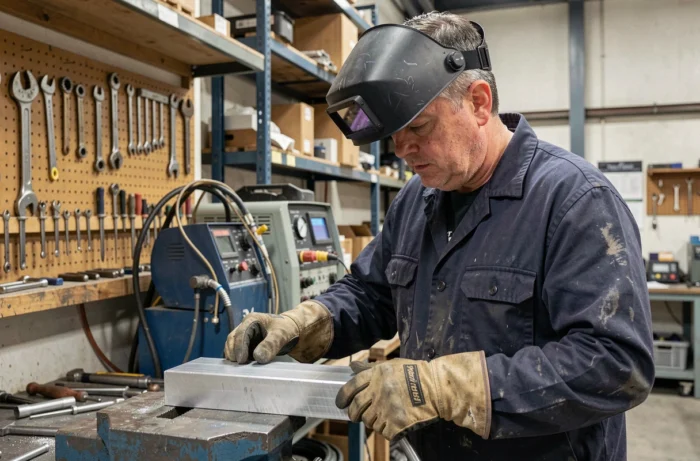
MIG welding of aluminum relies on an inert gas arc transfer between a consumable wire electrode and the workpiece to be assembled. This process, also known as GMAW, differs from MIG welding on steel due to the high thermal conductivity of aluminum and the presence of a superficial oxide layer whose melting point far exceeds that of the base metal.
Achieving a clean and strong bead requires a properly set-up machine, rigorous preparation, and some adjustments that typical guides tend to overlook.
Pulse MIG on aluminum: why pulsed mode changes the game
Most tutorials present pulsed mode as a premium option. In recent industrial practice, Pulse MIG is becoming the standard for aluminum fabrication, particularly because it meets visual quality requirements and limits porosity.
The principle is simple: the machine alternates between a peak current (which detaches a droplet of wire) and a lower base current (which maintains the arc without overheating the workpiece). On aluminum, this alternation offers three concrete advantages.
- Better control of the molten pool on thin materials, where a constant arc risks burning through the sheet in a matter of seconds.
- A notable reduction in spatter, which limits post-weld cleaning and improves the appearance of the bead.
- More consistent and aesthetically pleasing beads, with less risk of lack of fusion at the edges.
For a workshop welder or an advanced DIYer, switching from a classic MIG machine to a model incorporating pulsed mode represents a significant comfort gain. The additional cost at purchase is offset by the reduction in rework and scrap. Before choosing equipment, understanding MIG aluminum welding with a suitable machine allows for evaluating whether pulsed mode fits your usual assemblies.
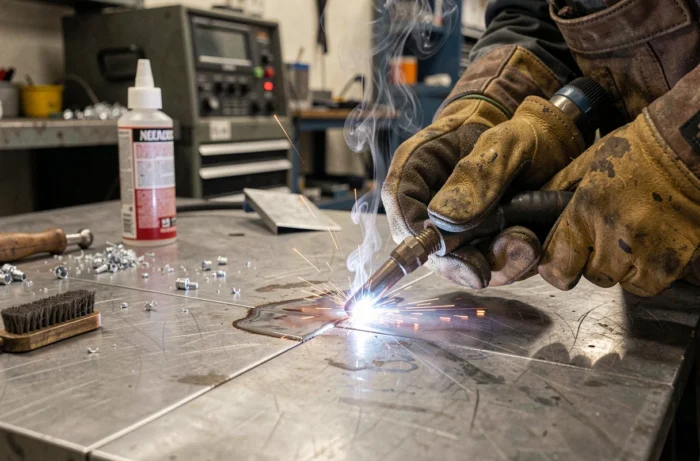
Ambient humidity and porosity: the invisible parameter of aluminum welding
Porosity remains the most common defect in MIG welding of aluminum. Traditional guides recommend cleaning the workpiece, which is necessary but insufficient. The humidity of the ambient air plays a direct role in the formation of micro-bubbles of hydrogen trapped in the bead.
Beyond a relative humidity of about 70%, the risk of hydrogen porosity increases significantly. Hydrogen, highly soluble in liquid aluminum, becomes trapped during the rapid solidification of the pool. The result: beads that appear correct but actually have internal cavities weakening the assembly.
Concrete measures to control the environment
Installing a hygrometer at the welding station allows for monitoring this parameter. When humidity exceeds the critical threshold, two options are available to the welder: slow down the pace to allow the pool to outgas longer, or postpone the operation if structural quality is a priority.
Air currents at the station constitute another underestimated factor. A flow of air that is too fast disrupts the argon shielding gas cone and allows the ambient atmosphere to contaminate the pool. Protecting the welding area with a windbreak or working in a ventilated enclosed space (but without direct airflow on the arc) reduces this risk.
Wire and torch preparation: adjustments that prevent jams
Aluminum is softer than steel. Its filler wire easily deforms in the feeding system, causing jams that many welders mistakenly attribute to the machine itself. A few mechanical adjustments can radically change the reliability of the wire feeding.
A spool gun eliminates most wire guiding problems by reducing the distance between the spool and the contact point to just a few centimeters. For machines equipped with a standard torch, replacing the steel liner with a Teflon or graphite liner reduces friction and limits wire flattening.
Roller tension and wire feed speed
The drive rollers should be U-grooved (not V-grooved, which flattens the aluminum wire). The clamping pressure should be set to the minimum necessary: the wire should advance without slipping, but excessive clamping flattens it and causes jams in the liner.
- Check that the liner is cut to the correct length, with no dead space at the torch entry.
- Use a contact tip with a diameter slightly larger than that of the wire, as aluminum expands with heat.
- Regularly clean or replace the contact tip, as the accumulation of micro-deposits of aluminum alters the arc.
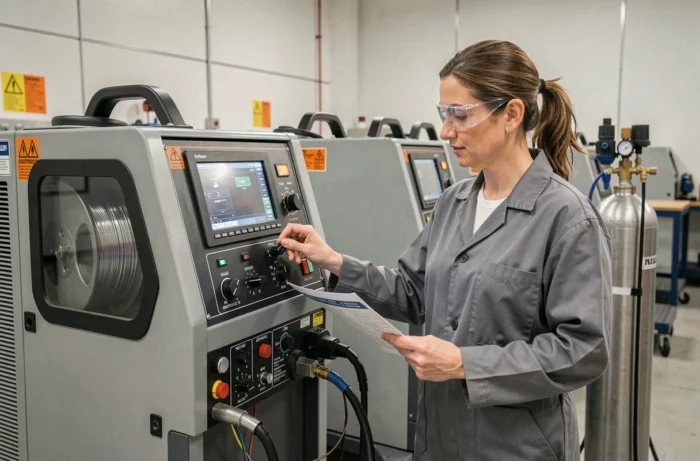
Adjusting argon flow and welding speed on MIG aluminum
The shielding gas for MIG welding of aluminum is pure argon, sometimes enriched with a small proportion of helium to increase penetration on thick pieces. Argon-CO2 mixtures used on steel should be avoided: carbon dioxide reacts with molten aluminum and generates oxides and porosity.
The argon flow is generally within a moderate range. Too low, it allows ambient air to contaminate the pool. Too high, it creates turbulence that sucks in outside air through the Venturi effect, negating the protection. An excessive gas flow protects less effectively than a properly calibrated flow.
Adapting the feed speed to the desired bead
The thermal conductivity of aluminum requires a faster welding speed than on steel. Advancing too slowly overheats the area and widens the pool to the point of losing control of the bead geometry. The technique involves pushing the torch (working angle tilted in the direction of advance), unlike steel welding where pulling the torch is often preferred.
Pushing the torch improves gas coverage in front of the pool and promotes better penetration on aluminum. This habit, counterintuitive for a welder trained on steel, is part of the fundamental adjustments of the MIG process applied to aluminum.
Each aluminum assembly in MIG relies on the balance between these parameters: transfer mode, atmospheric environment, wire mechanics, and gas protection. Neglecting any one of these factors is enough to produce a porous or fragile bead, even with a recent and high-performance machine.