
A 3D school diploma trains students in the creation of digital images in volume: modeling, texturing, rigging, animation, and rendering. In Rennes, this training opens doors well beyond video game or animation film studios. The Breton job market generates demand in sectors that classic job descriptions rarely mention.
Tech artist and VR technician: positions related to immersive entertainment in Rennes
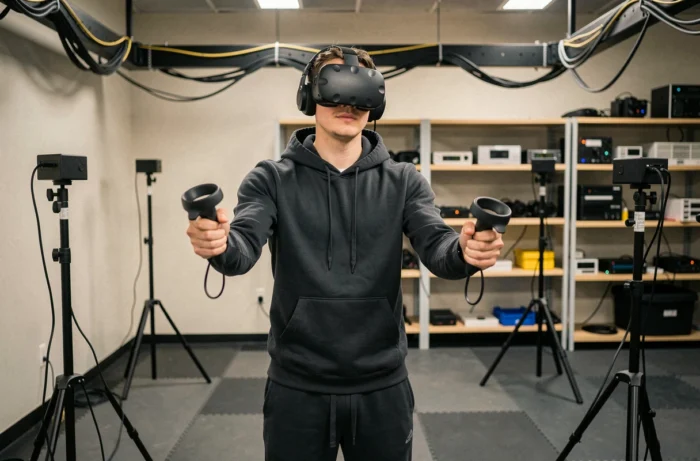
The opportunities from a 3D school are often presented through the lens of video games or animation films. Rennes offers another playground. Structures like Virtual Room Rennes or the EVA arenas, which host collaborative virtual reality experiences open to the public, utilize real-time 3D skills on a daily basis.
These places recruit or outsource to specific profiles: 3D artists specialized in real-time environments, tech artists capable of bridging visual creation and engine constraints (Unity, Unreal Engine), and VR technicians responsible for adapting, integrating, and maintaining immersive content on-site.
This type of position requires mastery of the 3D pipeline, but also an understanding of the performance constraints specific to real-time rendering: polygon budget, light baking, texture optimization. As detailed in CB News articles, these professional opportunities remain little visible in traditional career paths, even though they represent a concrete local reality.
Industrial 3D modeling: designer-drafter and mechanical design in Brittany
3D modeling is not only used to create characters or fictional settings. In Brittany, job offers for designer-drafters in mechanical design or REVIT drafters regularly appear on regional job platforms. These positions fall under study offices, industrial companies, construction, or electrical sectors.
The core skill remains the same: building precise digital volumes, reading and producing plans, manipulating CAD software. A graduate from a 3D school who masters geometric rigor and technical plan reading can pivot to these jobs without having to undertake a complete retraining.
Transferable skills between artistic 3D and technical CAD
The transition from artistic 3D to industrial CAD requires some adjustments:
- Learning a parametric CAD software (SolidWorks, CATIA, AutoCAD, or REVIT depending on the sector), while initial training often focuses on Maya, Blender, or 3ds Max
- Acquiring the technical vocabulary of the targeted sector (mechanics, structure, fluids, VRD) to communicate with engineers
- Developing a modeling approach focused on dimensioning and tolerances rather than visual rendering
The spatial logic and volumetric precision acquired in a 3D school provide a solid foundation for this transition. The adaptation time is more about industry culture than basic technical skills.
Animation and video game professions: creative positions after a 3D school
The most recognized paths remain those in the creative sector. A 3D school diploma in Rennes prepares students for several families of jobs in animation and video games, each corresponding to a stage in the production pipeline.
- 3D Modeler: creation of characters, props, and environments from 2D concepts. Work on topology, sculpting, and retopology
- 3D Animator: bringing characters and objects to life, managing animation cycles, lip-syncing for dubbing
- Rigger: building the digital skeleton that allows for the animation of models. A very technical position that often requires knowledge of scripting (Python, MEL)
- Lighting Artist and Compositor: managing the lighting of 3D scenes and final assembly of rendering passes in post-production
- Game Designer focused on level design: designing game levels, placing interactive elements, balancing difficulty
Rennes hosts a Ynov campus that specifically trains for these jobs with a bachelor’s and then master’s program. The city also hosts independent studios and production structures that recruit locally.
Graphic creation and digital design: opportunities at the intersection of 3D and communication
Some graduates move towards positions where 3D is a tool among others, serving a broader visual strategy. The motion designer combines 2D/3D animation, compositing, and editing to produce video content for social media, advertising, or internal corporate communication.
The digital art director oversees the visual identity of a project by integrating 3D elements into overall communication campaigns. This position typically comes after a few years of experience, but mastering the 3D production pipeline provides a differentiating advantage compared to a profile coming from pure 2D graphic design.
Architectural visualization and space design
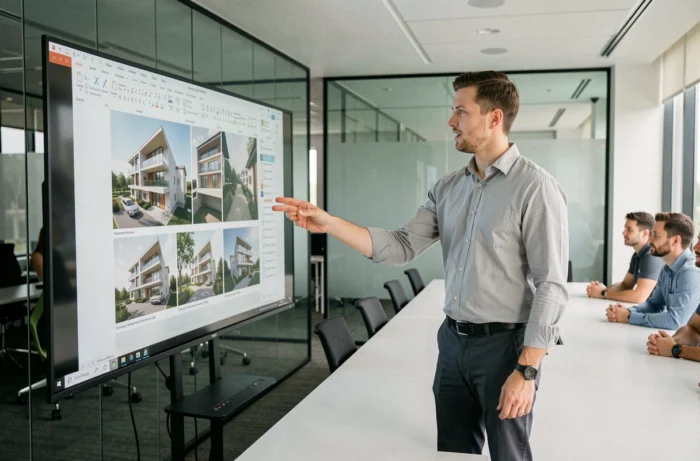
Architectural visualization (archviz) represents another concrete opportunity. Architecture firms and real estate developers commission photorealistic renders of projects before construction. A 3D graphic designer specialized in archviz produces still images and animations from architect plans, using rendering engines like V-Ray, Corona, or directly Unreal Engine for interactive virtual tours.
In Rennes, where the real estate market remains active, this type of service is in demand from local developers and architecture firms in the metropolitan area.
The range of jobs accessible after a 3D school diploma far exceeds the scope of video games. Between immersive entertainment, industrial CAD, animation, motion design, and architectural visualization, the specialization chosen at the end of the course determines the trajectory more than the diploma itself. Rennes offers a job market where these different fields coexist, allowing for career reorientation without changing cities.