
The French DIY market declined by 3.2% in 2025 according to FMB/Inoha data, with signs of stabilization emerging in 2026. This contraction does not reflect a lack of interest from individuals, but rather a repositioning of projects: fewer major renovations, more targeted interventions where the choice of tools and methods matter more than the budget.
Wireless tools and torque: what technical sheets don’t tell you
The widespread adoption of interchangeable battery platforms has changed the purchasing logic. We recommend thinking in terms of ecosystems rather than isolated tools: a compact impact driver, a trimmer, and an orbital sander sharing the same battery format cover most home projects without multiplying chargers.
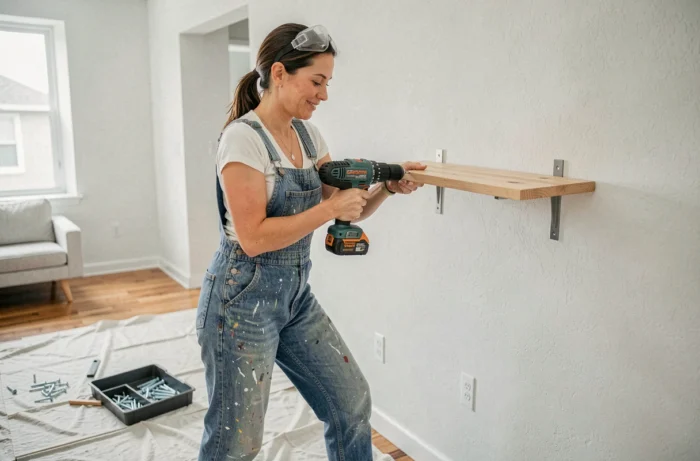
On impact drivers, the torque displayed in newton-meters remains a partial indicator. The impact rate and electronic torque control matter more to avoid shearing a screw in soft wood or cracking an MDF assembly. Models with a progressive mode allow for power adjustment on the last three or four turns, where a tool without regulation risks exceeding the appropriate tightening point.
A point rarely addressed in consumer guides: high-capacity batteries (like Powerstack or equivalents) change the center of gravity of the tool. On a cordless plunge router, this imbalance can compromise the straightness of a groove if the base is not firmly pressed down. We observe better results by reserving compact batteries for precision work and high-capacity batteries for heavy-duty tasks.
To stay updated on new tools and field feedback, the Monsieur Bricoleur news site compiles tests and comparisons that are regularly updated.
Light renovation after the drop in MaPrimeRénov’ aids
Requests for comprehensive renovations via MaPrimeRénov’ fell by about 75% in the first half of 2026, dropping from around 10,000 to 2,500 monthly applications. Stricter criteria and budget cuts have redirected some households towards projects that can be completed without subsidies.
DIY stores are becoming project advisors, not just distributors. This shift is reflected in a growing offer of in-store quotes, technical support, and integrated financing solutions.
For the savvy DIYer, this situation opens a concrete niche: taking on tasks previously entrusted to a craftsman. Insulating lost attics by blowing in insulation, replacing standard joinery, installing single-flow ventilation – these projects remain accessible as long as the corresponding DTUs are mastered and air-tightness requirements are met.
Prioritize quick return projects
Without public aid, the economic calculation changes. We recommend focusing efforts on interventions with a return on investment measured in months rather than years:
- Sealing openings (silicone or EPDM seals, sealing strips) significantly reduces thermal losses from the first winter, at a very low material cost.
- Replacing an aging water heater with a thermodynamic model remains one of the areas where solar self-consumption, if it already exists, pays off the fastest.
- Installing a wired or wireless programmable thermostat on an existing boiler takes less than two hours and improves consumption management without touching the hydraulic circuit.
Quiet DIY and brushless tools: real constraints in condominiums
Brushless motors are not silent, but they reduce mechanical vibrations by eliminating carbon friction. The nuance is important: the airborne noise generated by a circular saw blade or an SDS drill bit remains the same regardless of the motor type. The gain lies in the low frequencies transmitted through structures, which limits propagation in a building.
In condominiums, noise regulations do not set a decibel threshold for occasional DIY work, but require compliance with hours defined by prefectural order or condominium regulations. Before starting to drill into a party wall, checking the internal regulations remains the first step – some buildings prohibit work on Saturday afternoons.
Reduce noise at the source rather than at the output
Anti-vibration mats placed under the workbench absorb shocks transmitted to the floor. For cuts with a jigsaw, a fine-toothed blade (high TPI) produces less noise than a coarse-toothed blade, at the cost of reduced cutting speed. Choosing the right blade remains the most effective lever against cutting noise.
DIY training and skill development: what works
Several platforms offer certifications or structured courses for individuals wishing to go beyond video tutorials. Feedback from learners on these programs shows a common point: the most useful modules are those that require a validated practical exercise, not those that are limited to passive videos.
For a DIYer already comfortable with basic gestures, in-store or shared workshop workshops provide more than online courses, as they confront real materials and correct mistakes in real time. Handling a router under a table, for example, cannot be understood on screen: the pressure of the piece against the guide, the feed speed, the potential for backfire – all of this requires physical learning.
The DIY market is going through a maturity phase where the raw performance of tools matters less than their integration into a coherent ecosystem and their suitability for the actual project. Adapting one’s tools to the precise nature of the job, checking local regulatory constraints, and investing in technical skill development remain the three levers that separate a successful project from an abandoned job halfway through.