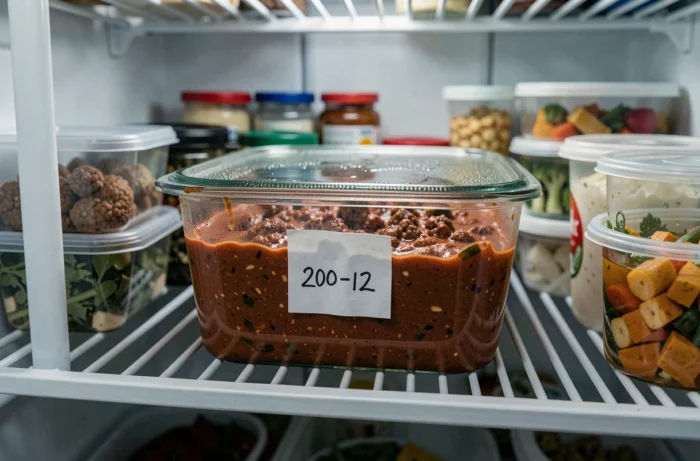
A homemade bolognese sauce made with ground meat does not behave like a simple tomato coulis. Cooked ground meat is classified as a highly perishable food by French health authorities, which significantly shortens the shelf life compared to a vegetable tomato sauce. We recommend not exceeding 2 to 3 days in the refrigerator, provided that the cold chain has been respected from the end of cooking.
Cooked ground meat and bacterial proliferation: why bolognese is more sensitive
Recently published storage guides clearly distinguish generic cooked dishes from preparations made with ground meat. A classic cooked dish (vegetables, whole fish, poultry pieces) can be kept for 3 to 4 days in a refrigerator maintained at 4 °C or lower. Cooked ground meat, on the other hand, offers a much larger surface area for bacterial contact than a whole piece of meat.
Grinding multiplies the interfaces between the flesh and the surrounding air during preparation. Even after cooking, the nutrients released and the relatively neutral pH of the meat create an environment favorable to mesophilic bacteria. Homemade bolognese sauce lasts 2 to 3 days in the fridge, no longer.
Tomatoes do provide acidity that inhibits certain pathogens. However, in a classic bolognese, the meat/tomato ratio and the addition of carrots, celery, or wine alter the final pH. The preservative power of tomatoes alone is not enough to compensate for the protein load of ground meat.
This point is often overlooked when applying the shelf life of a jar of store-bought tomato coulis to bolognese. The storage of bolognese sauce in the fridge follows rules specific to meat preparations, not those for vegetable sauces.
The 2-hour rule before refrigeration: an official guideline often ignored
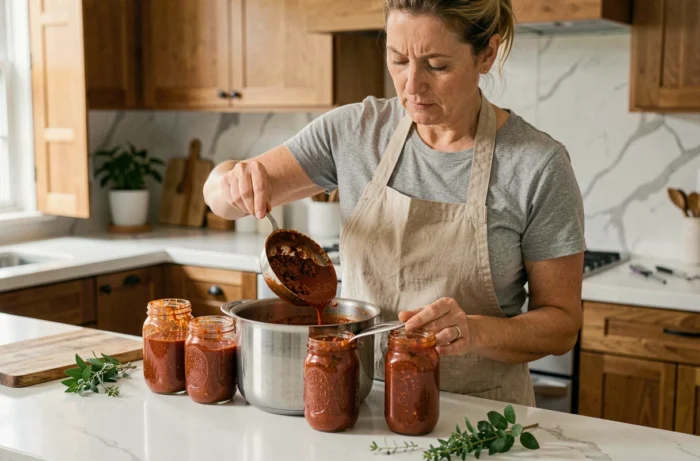
The Anses and the Ministry of Agriculture reaffirm that a homemade cooked dish should not remain at room temperature for more than 2 hours before being placed in the refrigerator. Beyond that, the theoretical shelf life in cold storage is no longer guaranteed.
In practice, we observe that many cooks leave their pot to cool on the stove for the entire evening. The intention is commendable (not to warm up the inside of the fridge), but the health risk far outweighs the thermal inconvenience.
Cool quickly without compromising the fridge
The most reliable method is to transfer the sauce into a wide, shallow container. A larger exposed surface area speeds up the cooling process. An inverted water bath (the container placed in a dish of cold water with some ice cubes) can bring the sauce below 10 °C in less than 30 minutes.
The Anses specifies that this guideline is particularly important for preparations made with ground meat. Refrigeration cannot compensate for too slow cooling: the toxins produced by certain bacteria (Bacillus cereus, Clostridium perfringens) can survive fridge temperatures once formed.
Signs of spoilage in bolognese sauce in the refrigerator
Counting the days is not enough. A temperature problem in the refrigerator, a poorly sealed lid, or an initial cooling period that is too long can shorten the actual duration well below the expected 2 to 3 days.
Here are reliable indicators to check before reheating bolognese stored in the fridge:
- A sour or rancid smell upon opening the container, distinct from the normal acidity of cooked tomato, indicates ongoing fermentation.
- A viscous film or bubbles on the surface indicate advanced bacterial activity, even if the sauce still appears red and homogeneous.
- A sharp or metallic taste upon the first bite (even before reheating) confirms spoilage. We recommend discarding the entire batch, not just the top layer.
- A localized brownish or greenish discoloration (mold) renders the sauce unfit for consumption, even after being heated to a high temperature.
In case of doubt, the principle remains simple: throw it away rather than risk food poisoning related to ground meat.
Freezing homemade bolognese sauce: duration and method
When the prepared quantity exceeds what the household can consume in 2 days, freezing is the only safe option. Homemade bolognese can be frozen without issue for 2 to 3 months in a freezer-safe airtight container.
Portioning and containers
Dividing the sauce into individual or family portions before freezing prevents thawing and then refreezing an entire block. Zip-top freezer bags, laid flat, freeze faster and store more easily than glass jars (which require headspace to avoid breakage).
Thawing ideally takes place in the refrigerator overnight before consumption. Directly transferring from the freezer to a saucepan over low heat also works, but can sometimes result in a grainy texture of the ground meat.
Reheating and temperature threshold
When reheating, the sauce must reach a vigorous boil maintained for a few minutes. Simply warming it in the microwave does not guarantee the destruction of bacteria that may have developed during the thawing phase.
Refrigerator storage: container mistakes that shorten shelf life
The choice of container directly influences preservation. Leaving the sauce in the cast iron pot with a loosely placed lid exposes the preparation to air exchange and odors from the refrigerator.
- Glass containers with airtight lids (like jars with a seal) limit oxidation and odor transfer.
- Food-grade plastic containers are suitable, provided that the lid seals tightly. The acidity of tomatoes can attack certain low-quality plastics and alter the taste.
- Plastic wrap placed directly on the surface of the sauce (in contact) reduces the air pocket and slows surface oxidation.
Placing the container in the coldest part of the refrigerator (usually the bottom section, above the vegetable drawer) ensures a stable temperature close to 4 °C. A fridge set above 5 °C reduces the shelf life of any meat preparation.
For a bolognese prepared on Sunday evening, the reasonable limit is Tuesday evening. Beyond that, it is better to have anticipated freezing right from the initial cooling rather than trying to extend storage in the fridge.