The Portuguese market for glyphosate 360 g/L is not just a price list. Three brand segments coexist in the territory, each with its own pricing logic. Understanding this segmentation allows for interpreting price differences without relying solely on the label of the container.
Segmentation of the Portuguese market: three families of glyphosate 360
In Portugal, glyphosate products dosed at 360 g/L are divided into three distinct categories: Bayer group brands (Roundup and its variations), generics manufactured in Europe, and Chinese products repackaged under local license.
This structure is not trivial. It directly determines price positioning, availability in agricultural cooperatives, and the level of trust among professional buyers. A farmer in Alentejo and a winemaker in Douro do not face the same offers depending on their usual distributor.
To compare glyphosate 360 brands in Portugal, one must first identify which segment each product belongs to, then relate the price to the actual cost per hectare treated.
Comparative table of glyphosate 360 segments in Portugal
The available data on the Portuguese market allows for a comparison by segment. Exact prices vary according to the distributor and the volume ordered, but relative differences remain stable.
| Segment | Examples of brands | Origin | Price positioning | Availability |
|---|---|---|---|---|
| Bayer / Roundup | Roundup 360 Plus, Roundup derivatives | Europe (Bayer) | High-end | Cooperatives, authorized distributors |
| European generics | Gallup 360, Barbarian, other local authorizations | Europe (Ireland, Poland, France) | Mid-range | Cooperatives, B2B online sales |
| Repackaged Chinese products | Brands under local license | China (repackaging Portugal) | Entry-level | Wholesalers, direct importers |
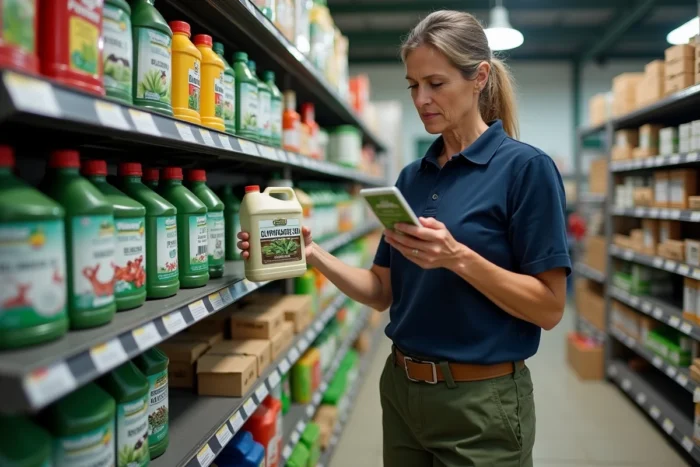
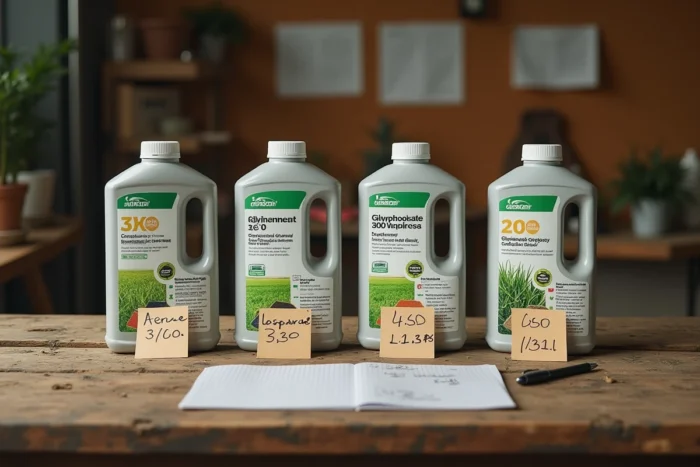
The gap between the Roundup segment and generics can be from one to two times for a 20-liter container. Repackaged Chinese products are positioned even lower, but their presence remains more variable depending on the regions.
Glyphosate 360 in Portugal: what affects the price beyond the brand
Comparing two containers of glyphosate 360 g/L solely on their face price leads to misjudgments. Several technical factors alter the actual cost of use.
- The type of salt and adjuvants: a glyphosate formulated with isopropylamine salt and integrated wetting agent does not dilute at the same ratio as a product without adjuvant. The cost per hectare treated changes, even at the same concentration of active ingredient.
- The purchase volume: a 5-liter container purchased at a cooperative costs proportionally more than a bulk order of 20 liters. Large-scale operations negotiate decreasing rates that smaller buyers do not obtain.
- The market authorization (AMM): in Portugal, only products with a valid AMM can be marketed legally. An imported product without local AMM, even cheaper, exposes the buyer to penalties. Checking the authorization number with the DGAV (Direção-Geral de Alimentação e Veterinária) remains a prerequisite for any purchase.
Thus, the price per liter is not enough. The cost per hectare treated is the only reliable indicator for comparing two products at 360 g/L.
Roundup versus generics: a justified gap?
The premium of Roundup compared to European generics is partly explained by the formulation (patented adjuvants, Transorb technology) and the brand’s reputation. However, the active ingredient remains the same: glyphosate at 360 g/L.
For standard agricultural use (weeding before sowing, maintenance of headlands), approved European generics offer comparable effectiveness in most conditions. The difference occurs in limited cases: treatment in cool weather, very clayey soils, resistant weeds.
European regulation and its impact on prices in Portugal in 2026
The renewal of glyphosate authorization at the European level has a direct effect on availability and prices in Portugal. Each reevaluation cycle causes adjustments in stock levels among distributors.
Regulatory costs weigh more heavily on small manufacturers than on Bayer. The approval files represent a significant investment, which reduces the number of generics on the Portuguese market compared to countries like France or Spain. Less competition means higher floor prices.
Portugal also applies specific taxes on phytosanitary products, varying according to the hazard classification. These taxes add to the wholesale price and can represent a significant portion of the final price on the shelf.
Buying in Spain for less: a false good idea?
The geographical proximity to Spain leads some buyers to consider cross-border purchases. Spanish prices are often lower due to a more competitive market and higher sales volumes.
The problem is regulatory. A phytosanitary product authorized in Spain is not automatically authorized in Portugal. Using glyphosate without Portuguese AMM constitutes an infringement, even if the active ingredient and concentration are identical. The AMM is national, not European, despite the community evaluation framework.
Practical method for comparing glyphosate 360 prices in Portugal
Rather than collecting prices from generalist sites, a structured approach yields better results.
- Identify the segment (Bayer, European generic, repackaged Chinese product) before comparing prices
- Systematically convert the price into cost per hectare treated, considering the recommended dilution rate on the label
- Check the AMM on the DGAV registry for each product considered
- Request quotes from two or three cooperatives for the same volume; the differences between distributors often exceed those between brands
The price displayed on an e-commerce site does not always reflect the actual price at the cooperative. Group purchases among neighboring farms remain the most effective negotiation lever in Portugal, where the agricultural cooperative network still plays a structuring role in phytosanitary distribution.