
The freesia is a bulbous plant native to South Africa, belonging to the iris family. In the language of flowers, this small fragrant bell carries specific meanings that make it a unique tattoo motif. Its name pays tribute to Friedrich Heinrich Theodor Freese, a 19th-century German physician and botanist, and its cluster shape earns it the nickname “Cape lily of the valley.”
Freesia Tattoo and Relational Dimension: Beyond a Simple Floral Motif
Most floral tattoos are chosen for their aesthetics. The freesia stands out because its symbolism directly touches on the bonds between people. In the language of flowers, this flower embodies lasting friendship, trust, and innocence. It also represents pure and sincere love, but with an emphasis on friendly fidelity rather than solely romance.
This relational interpretation opens up a use that rose or lotus tattoos do not cover. A tattooed freesia can embody the desire to mend a story, to forgive, or to forgive oneself in a past relationship. This dimension of reconciliation and restored connection remains underexplored in content about floral tattoos, even though it is documented in resources on the language of flowers.
To delve deeper into the meaning of the freesia flower tattoo, one must also consider the cultural context. In the United States, the freesia is the traditional flower for the seventh wedding anniversary, symbolizing trust and bonds that strengthen over time. This temporal marker gives the tattoo a narrative weight absent from most floral motifs.

Symbolism of Freesia Colors in Tattoos
The color of a freesia tattoo alters its interpretation. This is not a decorative detail: in the language of flowers, each shade of freesia carries a distinct message.
- White freesia: associated with innocence and purity, it is suitable for memorial tattoos or tributes to a deceased loved one
- Yellow freesia: linked to joy, optimism, and friendship, it is the most consistent shade for a tattoo celebrating a long-standing friendship
- Pink freesia: evokes maternal tenderness and sweet affection, often chosen for a tattoo dedicated to a female figure
- Red freesia: symbolizes passion and ardent love, closer to the emotional weight of a rose but with an acknowledged fragility
- Purple freesia: associated with spirituality and elegance, it directs the tattoo towards a more introspective dimension
For a black and gray tattoo (fine line), color disappears. The meaning then relies on the bell shape and the cluster composition, which remain recognizable even in a minimalist style.
Monochrome or Color Freesia Tattoo: What Style Changes
Fine line, very popular for floral tattoos, captures the delicacy of the freesia well. The slender stems and funnel-shaped petals lend themselves to a clean outline. In contrast, a colored watercolor or neo-traditional freesia allows for play on the chromatic symbolism described above.
The choice between these two approaches is not purely aesthetic. A colored freesia carries a double message, through the flower and its hue. A monochrome freesia concentrates the entire interpretation on the shape and placement.
Placement of the Freesia Tattoo: Areas and Associated Interpretations
The location of a floral tattoo alters its interpretation. The freesia, with its elongated stem and cluster of bells, fits better in certain areas than others.
The inner wrist and forearm are the most common placements for a freesia tattoo. The elongated shape of the floral stem naturally fits these areas. A freesia on the wrist remains visible and legible, reinforcing its function as a daily reminder of a bond or personal commitment.
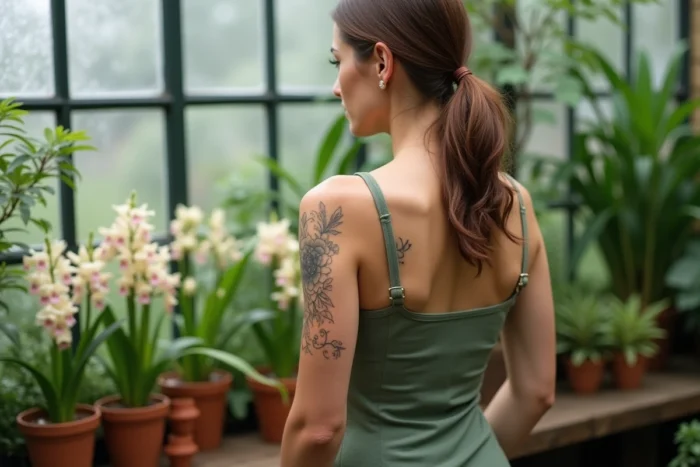
The collarbone and shoulder accommodate a cluster composition well, with several flowers arranged along the bone. This area allows for a larger format while maintaining the lightness of the motif. The ankle and foot, on the other hand, pose a technical problem: the fine line’s delicacy ages less well in these areas subject to constant friction.
The back and ribs offer space for compositions combining the freesia with other elements (foliage, butterfly, inscription). These placements are less common but allow for the development of a more complex visual narrative around the flower.
Freesia and Other Tattoo Flowers: What Distinguishes It
The freesia occupies a unique place in the hierarchy of floral tattoos. The rose dominates the market for sentimental tattoos. The lotus has become the symbol of spiritual resilience. The cherry blossom embodies impermanence. The freesia, however, does not belong to any of these major categories.
Its specificity is being a relational flower turned towards others, not towards oneself. While a lotus tells a personal transformation, a freesia tells a connection. This distinction makes it a relevant choice for friendship tattoos, duo tattoos (each person has a freesia of a different color), or tattoos commemorating a rebuilt relationship.
The bell shape of the freesia also makes it visually distinct. At the same size, it is more recognizable than jasmine or sweet pea flowers, which can blend in fine line. This strong graphic identity compensates for its lesser notoriety compared to “classic” tattoo flowers.
The freesia remains a relatively uncommon tattoo choice, which is both its advantage and its limitation. The advantage: it surprises and allows for conversation. The limitation: the tattoo artist must master botanical references to avoid producing a generic flower. Bringing a precise reference photo to the consultation remains the best guarantee of a result faithful to the desired symbolism.