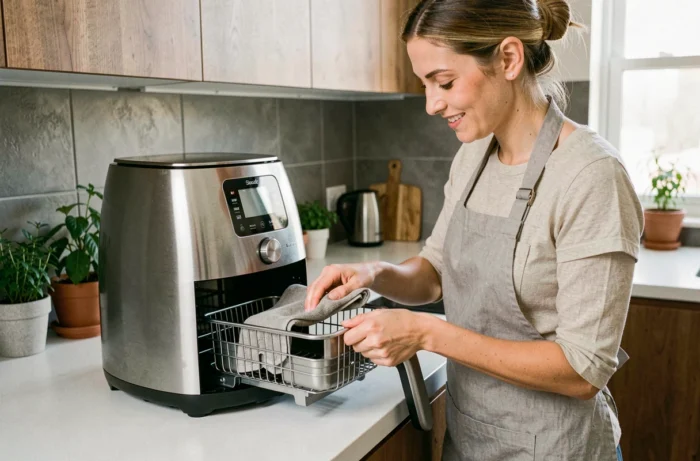
Between a welded tank that is impossible to degrease and a model where every part is dishwasher-safe, the cleaning time after each use varies considerably. The ease of maintenance of a fryer depends on specific technical parameters that product sheets do not always highlight. This guide compares the mechanisms that truly simplify cleaning, from the oil filtration system to the design of the tank.
Automatic Oil Filtration: The Criterion That Guides Overlook
Most comparisons evaluate the ease of cleaning a fryer based on two criteria: removable tank and dishwasher compatibility. However, a third parameter changes the game on a daily basis: automatic oil filtration.
Models like the Tefal Oleoclean Compact incorporate a system that transfers used oil to a separate reservoir while filtering it in the process. The filtered oil reservoir can be washed with soapy water or in the dishwasher, and the main tank no longer needs to be handled full of oil. This device reduces the frequency of deep degreasing of the tank.
Several international comparisons now consider this type of system as a maintenance ease criterion on par with the removable tank. The concrete benefit: no need to transfer hot oil into a bottle, a messy and risky operation. To choose an easy-to-clean fryer, checking for the presence of an integrated filtration circuit saves time on each usage cycle.
Oil Fryer vs. Hot Air Fryer: Cleaning Comparison
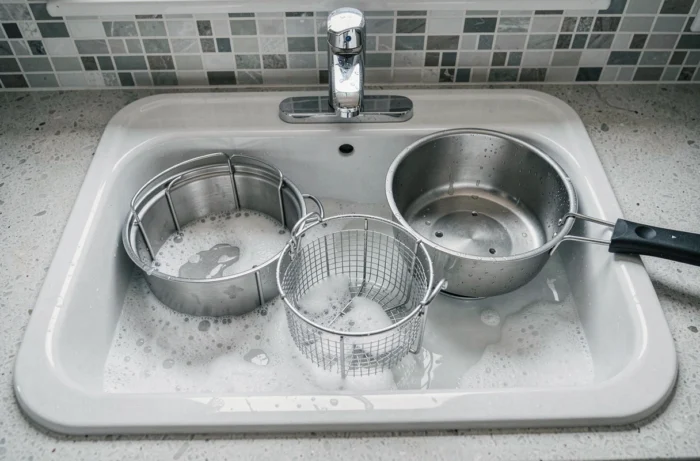
The type of fryer determines the nature of residues and thus the difficulty of maintenance. The table below contrasts the two main families based on the criteria that matter after cooking.
| Criterion | Oil Bath Fryer | Hot Air Fryer |
|---|---|---|
| Main Residues | Oil, embedded greasy deposits | Light splatters, crumbs |
| Removable Tank | Depends on the model (absent on entry-level models) | Removable drawer on most models |
| Dishwasher Compatibility | Variable (tank, basket sometimes yes) | Drawer and rack compatible on most references |
| Integrated Oil Filtration | Present on some models (Tefal Oleoclean, All-Clad) | Not applicable |
| Frequency of Deep Cleaning | After each oil change | After each use (quick) |
| Average Cleaning Time | Longer (degreasing necessary) | Shorter (a quick wipe is often sufficient) |
Hot air fryers generate less greasy residue, which shortens cleaning time. On the other hand, oil bath models with automatic filtration partially compensate for this gap by limiting the soiling of the tank between two emptying.
The Case of Traditional Plate Fryers
Classic fryers (pot, basket, lid) sold for less than 30 euros have an often-overlooked advantage: all their parts are dishwasher-safe. The absence of electronics and built-in heating simplifies disassembly.
In contrast, they lack a cold zone and odor filter, which leads to faster soiling of the bottom of the pot by carbonized residues.
Anatomy of an Electric Fryer Designed for Maintenance
Beyond the type of appliance, certain design details significantly facilitate cleaning. Here are the elements to check before purchase:
- Removable tank with non-stick coating: it detaches from the motor block and can be cleaned separately, by hand or in the dishwasher. Without a removable tank, degreasing requires cleaning around the heating element, complicating the operation.
- Cold zone under the heating element: frying residues fall into a low-temperature area where they do not carbonize. The tank remains cleaner between cleanings.
- Replaceable odor filter: it does not directly intervene in cleaning, but a saturated filter leaves greasy deposits on the lid, adding a surface to degrease.
- Dishwasher-compatible basket and lid: these parts accumulate splatters. Being able to place them directly in the dishwasher reduces manual maintenance time.
The Steba DF 300, for example, offers three separate baskets to fry different foods simultaneously. This configuration multiplies the parts to wash, but since each element is smaller, putting them in the dishwasher remains simple.
Tefal Oleoclean vs. Moulinex Super Uno: Two Approaches to Cleaning
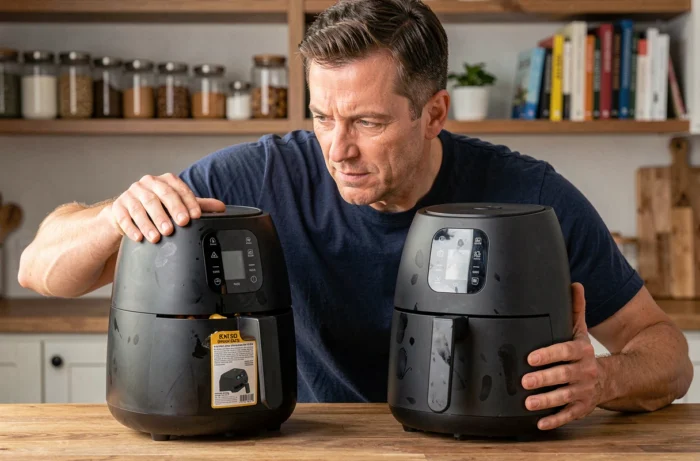
These two models frequently appear in selections of easy-to-maintain fryers, but their logic differs.
The Tefal Oleoclean focuses on automatic filtration and a separate oil reservoir. The filtered oil is stored in a removable container, which avoids handling the full tank. The system reduces contact with used oil and the risk of splashes during cleaning.
The Moulinex Super Uno takes a more classic approach: removable tank with non-stick coating, smooth walls without corners, and dishwasher compatibility for the basket. The emphasis is on ease of disassembly rather than oil management.
The choice depends on the frequency of use. For weekly or more frequent frying, the automatic filtration of the Oleoclean limits the accumulation of residues and spaces out deep cleanings. For occasional use, the quick disassembly of the Super Uno is more than sufficient.
Hot Air Fryers: Ninja Foodi and Philips Air Fryer
Double drawer models like the Ninja Foodi Dual Zone allow each compartment to be washed independently. The drawer is removable, goes in the dishwasher, and the base only requires a wipe.
The Philips Air Fryer Series 2000 features a non-stick coated basket that cleans in just a few minutes. The total absence of oil eliminates the need for degreasing, the main time-consuming task in maintaining a classic fryer.
Safety Standards and Impact on Tank Design
European standards governing household appliances have recently been updated by CENELEC (European Committee for Electrotechnical Standardization). These changes affect the safety of domestic cooking appliances, with strengthened requirements for thermal insulation and stability.
For fryers, this translates into better-insulated tanks and more robust lid locking systems. These design constraints have a positive indirect effect on cleaning: better-designed tanks limit oil leaks and splashes on the motor block, reducing the surfaces to clean.
The criterion that best summarizes the ease of maintenance of a fryer remains the number of removable dishwasher-safe parts. A fryer whose tank, basket, lid, and filtration reservoir are all machine washable requires less than ten minutes of attention after each use, regardless of the cooking type.