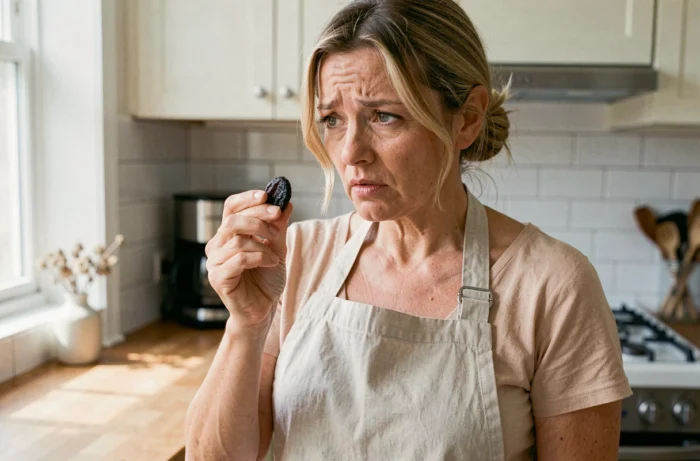
A bag of prunes found at the back of the cupboard, with a date that has passed for several months: the situation is common. Since the prune is a dried fruit with low water content, its shelf life far exceeds that of most fresh foods. The question of whether expired prunes can be eaten deserves a more technical answer than a simple yes or no, as several parameters determine the actual safety of the product after the date indicated on the packaging.
DDM and DLC on prunes: two terms that do not mean the same thing
Prunes sold in supermarkets almost always carry a minimum durability date (DDM), recognizable by the phrase “best before”. This wording does not indicate a health hazard beyond the date. It signals that the manufacturer no longer guarantees the product’s suitable taste qualities: texture, flexibility, aroma.
The DDM is distinct from the use-by date (DLC), which is reserved for perishable goods such as fresh meat, fish, or dairy products. Dried fruits fall under the DDM, not the DLC, which fundamentally changes the risk assessment. Exceeding a DDM by a few weeks or even months does not mean that the product is unfit for consumption.
However, the absence of a DLC does not exempt one from checking the actual condition of the prune before eating it. The date on the packaging remains a guideline, not an absolute guarantee in either direction.
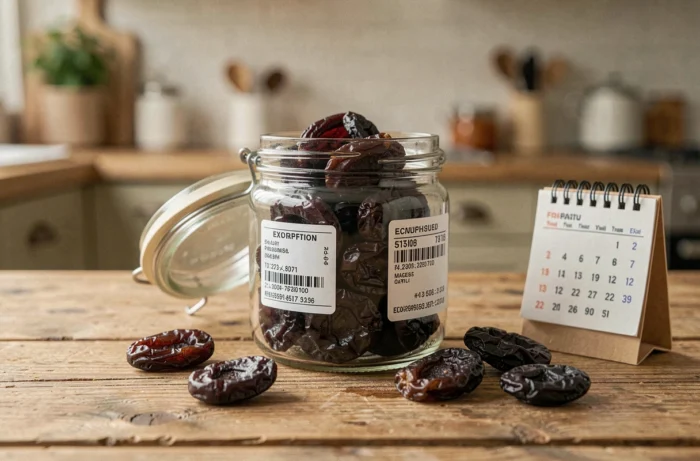
Microbial survival in dried fruits: what labels do not specify
The prune is a dry environment, with very low water activity. This characteristic prevents the multiplication of most bacteria and molds. Many online sources stop there, concluding that dried prunes are “safe indefinitely.” The microbiological reality is more nuanced.
A framework developed with the support of ILSI Europe to classify the microbiological risks of dry ingredients, including dried fruits, reminds us of a point often overlooked: the absence of microbial growth does not mean the absence of survival of pathogenic bacteria. Some microorganisms can persist for long periods in a dry environment without multiplying, then become active again if conditions change (rehydration, increased humidity).
This framework recommends that professionals document the storage history (temperature, humidity, duration) for dry ingredients. For an individual, the practical translation is simple: a bag of prunes stored in a cool, dry cupboard for a year after the DDM does not present the same risk profile as a bag left open in a humid kitchen for six months.
Storage conditions matter more than the date
Temperature, exposure to humidity, and the type of container directly influence the actual shelf life of prunes. An airtight bag, kept away from light and heat, preserves the product well beyond the DDM. A poorly sealed bag in a warm environment accelerates drying, promotes sugar oxidation, and can create a breeding ground for surface molds.
- Airtight container (glass jar, resealed zip bag): extends quality for several months after the DDM
- Stable ambient temperature below 20 °C: limits oxidation and texture loss
- Absence of visible moisture or condensation in the bag: indicates the product remains in a safe zone
- Neutral or slightly sweet smell: a prune that smells fermented or sour should be discarded
Expired prunes: concrete signals to decide
Beyond the date and storage conditions, sensory examination remains the most reliable filter for a consumer. Prunes are high-sugar fruits, making them resistant to degradation, but not invulnerable.
A hardened prune is not necessarily dangerous. The loss of flexibility indicates a gradual evaporation of residual moisture. The fruit becomes less pleasant to chew, but this alteration is of an organoleptic nature, not a health concern. A quick rehydration in warm water often suffices to restore an acceptable texture for cooking.
Real warning signals are of another order:
- Presence of visible mold (white, green, or gray spots on the surface): the prune must be discarded, along with those touching it in the bag
- Fermented, acidic, or unusual smell: a sign of microbial activity or sugar fermentation
- Altered taste (bitterness, acidity) from the first bite: do not insist
- Insect infestation (food moths, visible larvae): the entire batch is compromised
The presence of a crystalline white coating is not mold. It is generally sugar that has migrated to the surface, a common phenomenon on very sweet dried fruits stored for a long time. This deposit is harmless and can be distinguished from mold by its dry appearance and crunchy texture under the finger, whereas mold is fluffy or moist.
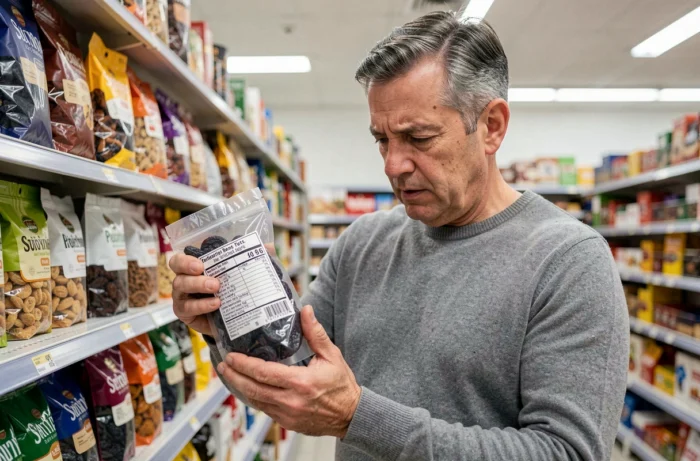
Food waste and prunes: a product often discarded wrongly
Dried fruits are among the most frequently thrown away foods even though they remain consumable. The confusion between DDM and DLC fuels this reflex. A prune whose minimum durability date has passed by several months retains its nutritional qualities in most cases, particularly its fiber and potassium content.
French regulations do not prohibit the sale of products whose DDM has passed, provided that the distributor deems the product still fit for consumption. Some anti-waste businesses use this as a selling point. For an individual, the logic is the same: a visual and olfactory check is enough to make an informed decision.
The prune remains one of the most stable dried fruits due to its low water activity and high sugar concentration. As long as storage has been correct and sensory examination reveals nothing abnormal, throwing it away solely because a date has passed amounts to wasting a food that is still perfectly consumable.