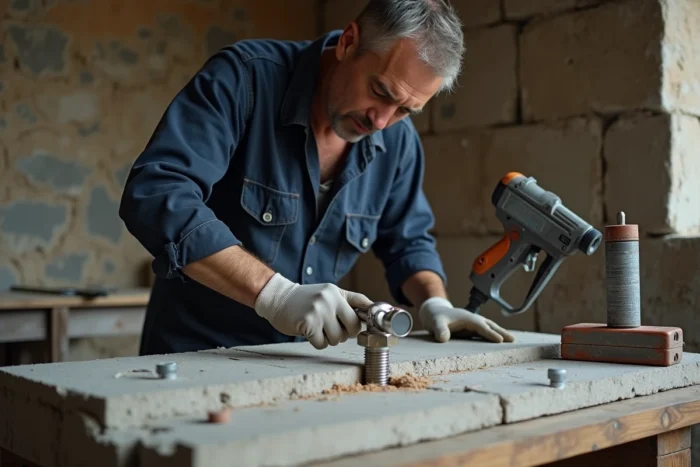
Chemical anchoring relies on the injection of a two-component resin into a drilled hole, where it polymerizes to bond a threaded rod or a bolt to the substrate. On concrete or cinder block, the technique is well documented. On natural stone and wood, two parameters change radically: the porosity of the substrate and its reaction to drilling. If not anticipated, these parameters can turn a theoretically solid fixation into a fragile anchor.
Drilling in natural stone: rotation only and diamond drill bit
Most chemical anchoring guides recommend drilling with a hammer drill. On natural stone, this approach poses a concrete problem: the percussion generates micro-cracks in the material, especially when the stone is brittle or layered (slate, certain soft limestones, porous sandstone).
The recommendation for this type of substrate is drilling with rotation only, using a diamond drill bit. The diamond drill bit cuts the material without impacting it, which limits the production of dust and preserves the integrity of the hole walls. A hole with clean walls improves the mechanical adhesion of the resin.
Performing a chemical anchor in natural stone and wood also requires thorough cleaning after drilling. On stone, the residual dust is finer and more abundant than with concrete. A brush suitable for the diameter of the hole, followed by blowing (two to three passes), remains the most reliable protocol before injection.
Dense stone or porous stone: the choice of resin changes
Not all natural stones react the same way to resin. The distinction to remember opposes dense stones (granite, marble, certain hard limestones) to very porous stones (tuff, Caen stone, soft sandstone).
On dense stone, a standard polyester or vinylester resin ensures complete polymerization without difficulty. The resin stays in the hole, coats the rod, and hardens normally.
On a very absorbent stone, the resin can be “absorbed” by the substrate before it has polymerized. The injected volume is no longer sufficient to fill the hole or properly coat the threaded rod. The result: a pull-out resistance much lower than what the product claims on its packaging.
Two solutions exist to counter this phenomenon:
- Apply a bonding primer or pore filler on the walls of the hole before injection, to reduce the capillary absorption of the stone
- Increase the volume of resin injected by anticipating the loss due to absorption, which requires calibrating the amount to the diameter and depth of the hole
- Prefer a vinylester resin, whose higher viscosity limits migration into the pores of the material
Chemical anchoring in wood: sieve and specific constraints
Wood is not a mineral material. Its fibers, moisture content, and variable density complicate chemical anchoring. Without precautions, the resin infiltrates the fibers instead of forming a coherent block around the rod.
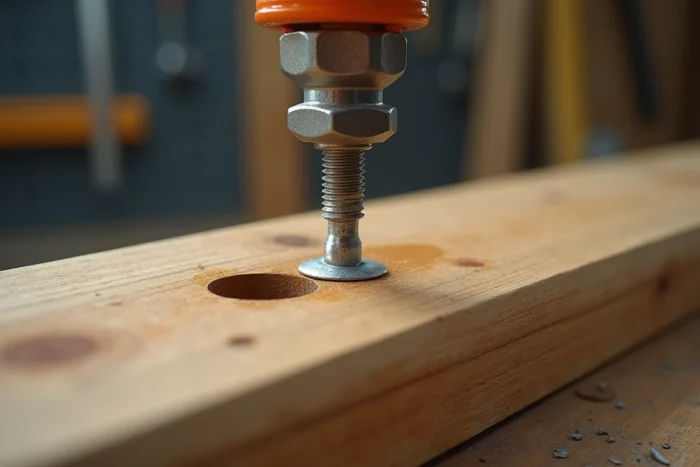
The use of a bonding sieve (a mesh sleeve inserted into the hole) is the most effective method for wood. The sieve contains the resin within a defined volume, prevents it from migrating into the surrounding fibers, and creates a homogeneous anchoring zone. Without a sieve, anchoring in solid wood or glued laminated timber yields random results.
The diameter of the drilling must be adapted to the sieve, not directly to the threaded rod. A hole that is too wide compared to the sieve leaves a play that reduces the contact area between resin and substrate. A hole that is too tight prevents the proper insertion of the sleeve.
Fresh softwood poses an additional problem: sap can interfere with the polymerization of certain polyester resins. On softwood, an epoxy or vinylester resin offers better chemical compatibility.
Resin and moisture: vinylester in exposed environments
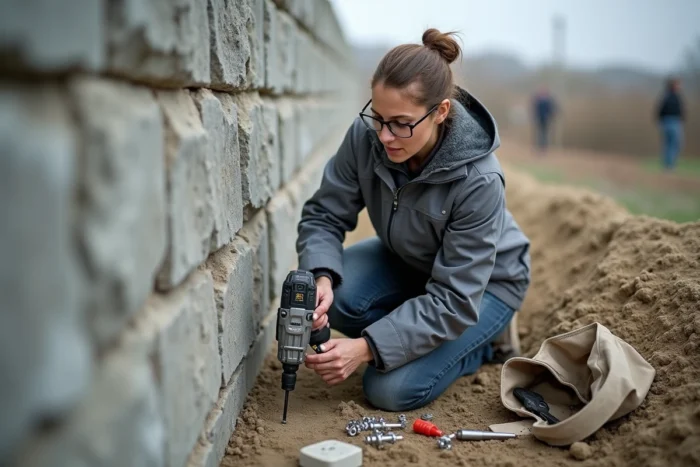
Outdoors, natural stone and wood are exposed to the elements. Residual moisture in the hole at the time of injection is the most frequent failure factor on these two substrates.
The hierarchy of resins according to their moisture tolerance is summarized as follows:
- Polyester resin does not tolerate moisture well and is only suitable for perfectly dry indoor substrates
- Vinylester resin tolerates slightly damp substrates, making it suitable for outdoor anchoring on stone or wood
- Epoxy resin offers the best mechanical resistance but requires longer polymerization times, especially in cold weather
If the hole is flooded or if the stone is waterlogged after prolonged rain, it is better to postpone the intervention rather than attempt an anchoring that will not polymerize correctly. Protecting the area with a tarp the day before the intervention allows for work on a dried substrate.
Polymerization time and load application: do not rush the fixation
The complete polymerization of a anchoring resin varies according to ambient temperature and the type of resin. On natural stone and wood, two common mistakes occur: tightening the fixation too early and stressing the anchor before complete hardening.
In cool weather (below about ten degrees), the curing time can double compared to the indications given for a reference temperature around twenty degrees. On exterior wood in autumn or early spring, this variable is often underestimated.
Applying a tightening torque to the threaded rod before complete polymerization creates shear in the still plastic resin. The result is a fixation whose pull-out resistance remains much lower than its nominal value. Respecting the curing time indicated by the manufacturer, then adding a safety margin when the temperature is low, remains the only reliable method.
Natural stone and wood require a different approach than concrete or cinder block. The choice of resin, the drilling method, the use of a sieve in wood, and moisture management are the four parameters that separate a durable anchoring from one that will fail under load.