
Receiving a letter or email mentioning the DGT (Dirección General de Tráfico) after a stay in Spain raises an immediate question: is it a real fine or an attempt at fraud? Since 2026, the DGT and INCIBE (National Cybersecurity Institute of Spain) have been warning about a wave of fake traffic violation notices written in French and specifically targeting foreign drivers. Distinguishing an official document from a scam relies on verifiable criteria, which this article details point by point.
Criteria for distinguishing between an authentic DGT fine and a scam
| Criterion | Authentic DGT fine | Fake notice (scam) |
|---|---|---|
| Sending channel | Registered postal mail or notification via the sede electrónica (official electronic headquarters) | Email, SMS, paper notice slipped under the windshield |
| QR code on the document | No QR code is included for payment | QR code redirecting to a fake payment site |
| Payment site domain | Official domain in .gob.es or .es linked to the DGT | Domain in .eu, .com or subdomain imitating the sede electrónica |
| Language | Spanish (sometimes accompanied by a rough translation) | Carefully written French, fully translated interface |
| Imposed payment deadline | Regulatory deadline of 20 days for reduction | Artificial urgency (“payment within 24 hours”) |
| File number | Verifiable on the official DGT website | Fictitious number, non-verifiable |
This table summarizes the alerts published by the DGT and INCIBE throughout 2026. The most distinguishing point remains the QR code: the DGT never uses a QR code for the payment of a fine. A notice that includes one is fraudulent.
To deepen the understanding of an official letter and comprehend the mandatory mentions, a detailed guide on multas dgt es en français allows for comparing each element of the received document with the Spanish regulatory standards.
QR code scams and fake DGT SMS: documented techniques in 2026
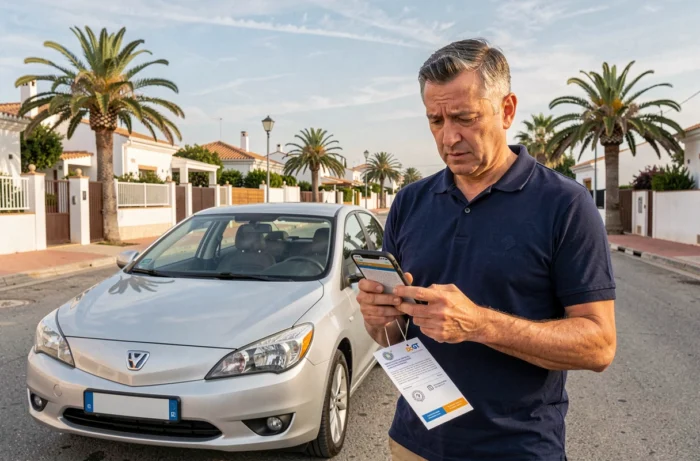
INCIBE has documented a technique called “qrishing”: fake DGT violation notices, printed on paper with the Spanish ministry logo, are placed on the windshields of vehicles registered abroad. The printed QR code redirects to a site that replicates the interface of the official sede electrónica.
The difference with classic email or SMS scams lies in the physical medium. A paper slipped under a windshield in a Spanish parking lot seems more credible than an email received weeks later. INCIBE specifies that this technique primarily targets foreign plates, as local drivers are more familiar with official channels.
Concrete warning signs on a fake paper notice
- The document demands immediate payment via QR code, while the official procedure goes through registered mail or the sede electrónica
- The payment site address does not end with .gob.es (for example: domains in .eu or misleading subdomains)
- The displayed amount does not correspond to any known scale, or the document does not mention a verifiable file number
- The text is entirely written in French, with no mention in Spanish, which is contrary to the DGT’s administrative practice
Fake SMS follow a similar logic. The message indicates an unpaid fine and demands payment within 24 hours, with a link to a fraudulent site. The DGT never sets a payment deadline shorter than 20 days.
Verification of a DGT fine: the sede electrónica as the only reliable channel
The sede electrónica of the DGT (accessible via the official site in .gob.es) is the only portal where a foreign driver can verify the existence of a fine in their name. The consultation requires an identification number (NIE for residents, or the file number appearing on the received letter).
In contrast, private platforms like MyFines (sct.myfines.eu), used by some autonomous communities like Catalonia, add a layer of confusion. These sites are legitimate for fines issued by the Servei Català de Trànsit, but their .eu domain fuels distrust. Checking the domain and cross-referencing with the sede electrónica remains the only reliable method.
Difference between national DGT fine and Catalan regional fine
Fines from the DGT (Spanish State) and those from the Servei Català de Trànsit (Catalonia) do not use the same notification channels. The DGT exclusively uses its sede electrónica and postal mail. The Servei Català de Trànsit has outsourced the management of foreign payments to the MyFines platform.
This distinction is crucial. A notice received via sct.myfines.eu for an infraction committed in Catalonia may be authentic, even if the domain seems suspicious. For an infraction committed elsewhere in Spain, any notice redirecting to a domain other than .gob.es should be considered fraudulent until proven otherwise.
Reduction of the DGT fine and regulatory payment deadline
The Spanish system provides for a significant reduction in the amount if payment is made within 20 days following the notification. This deadline also applies to foreign drivers, provided that the notification has indeed been received through official channels.
Scams exploit precisely this mechanism. By creating artificial urgency (shortening the deadline to 24 or 48 hours), they push the driver to pay without verifying. A deadline shorter than 20 days is a reliable marker of fraud.
Failure to pay an authentic fine can lead to consequences within the European Union, through cross-border cooperation mechanisms. No points are deducted from the French license, but an unpaid debt may be subject to a recovery procedure in the country of residence.
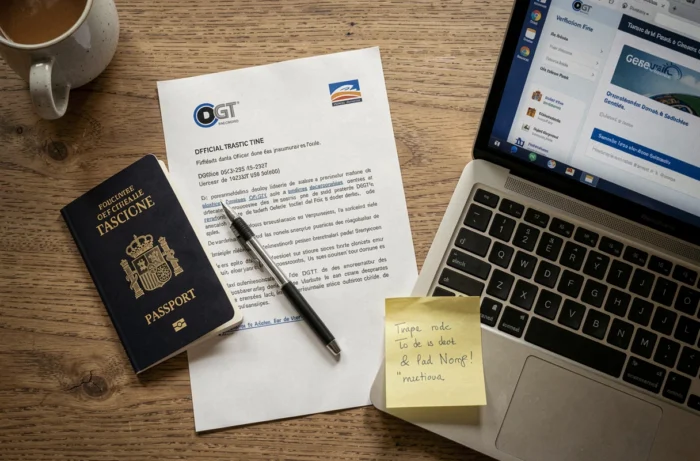
The quickest filter to assess a DGT fine notice received in French consists of three checks: absence of QR code, domain in .gob.es, payment deadline of at least 20 days. If any of these criteria are missing, caution dictates not to pay anything before consulting the DGT’s sede electrónica directly.