
In the evening, between emptying the backpack, starting dinner, and disputes over bath time, fatigue turns every task into a trial. Easing the daily life of moms and their children doesn’t require military organization, but rather a few concrete adjustments that relieve mental load where it weighs the most.
Birth leave and compensation: what changes for parents in 2026
Have you noticed that parental leave is rarely discussed in articles about family organization? Yet, it changes how a household can distribute presence at home.
As of July 1, 2026, the new birth leave replaces the old system. Compensation starts at 70% of net salary in the first month, then drops to 60% in the second, with rules for ceilings and notice periods to be respected. This decreasing mechanism encourages anticipating income loss rather than suffering it.
The right to traditional parental leave still exists, but it now operates with a sharing logic between both parents. A parent who takes the entire leave alone may lose part of the total compensation provided by the system. In practice, splitting the weeks between both parents benefits the household more.
This reform requires couples to discuss before the birth: who takes what, for how long, and with what impact on the monthly budget. To explore other avenues for daily parental organization, a useful resource: https://mamanetmoi.eu/.

Evening routine with children: replacing the task list with fixed sequences
Planning menus or preparing things the night before are well-known tips. Their limitation is that they remain isolated. A planned menu is useless if bath time goes awry and dinner burns.
A more effective approach is to set short and always identical sequences. For example: arriving home, fifteen minutes of reunions (no screens, no instructions), then bath, then dinner. The order never changes, regardless of the day.
Why a fixed order reduces conflicts
A child who knows the sequence of events resists less. They don’t negotiate bath time if it always happens at the same moment. Predictability replaces negotiation.
The common trap: wanting to adapt the sequence based on daily fatigue. It’s tempting, but each modification reignites negotiation. Better to have an imperfect but stable sequence than an adapted schedule that differs every evening.
Involve children in the sequence
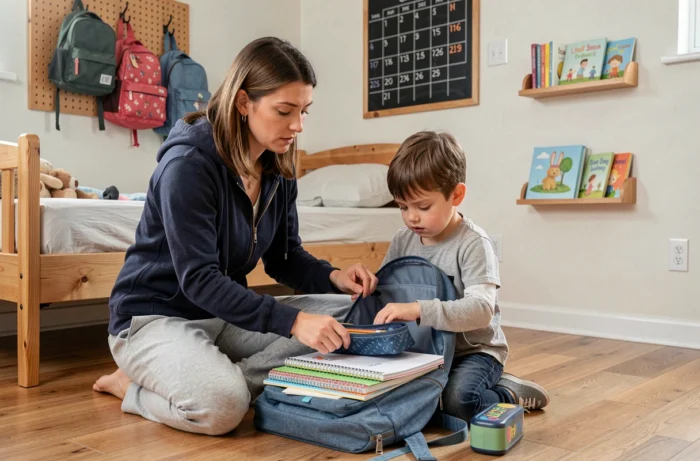
From the age of three or four, a child can manage a micro-step on their own: placing their shoes in the same spot, putting dirty laundry in the bin, choosing between two already decided menus. Each micro-task assigned to the child lightens the parental mental load without imposing too heavy a responsibility.

Children’s clothing and belongings: the real time saver comes from reduction
Organizing children’s clothes and accessories consumes disproportionate time. Before looking for a better storage system, the question to ask is: how many pieces are actually worn?
Most children rotate through five or six outfits. The rest clutters the drawers, complicates laundry sorting, and slows down morning choices. Reducing the wardrobe to about ten tops and bottoms per season eliminates the problem at the source.
- Remove clothes that are too small or never worn at the beginning of the season, not gradually, to avoid constant sorting
- Assign a single bin or compartment per child, at their height, so they can help themselves as soon as they are able
- Group diapers, bodysuits, and baby accessories in a single mobile container (basket, bag) that can be moved from room to room instead of multiplying stocks
This principle of reduction also applies to toys. A child who has access to too many toys simultaneously plays less with each one. Rotating toys (one accessible box, the others stored) maintains interest without needing to buy more.
Delegating without guilt: an underutilized lever by moms
Delegating doesn’t mean entrusting the children to someone else. It starts with household tasks that no one needs to do themselves: online shopping, occasional cleaning, batch meal preparation on weekends with a partner.
Home assistance services are expanding their scope in 2026, with interventions now covering support in the daily lives of families (not just the elderly). Inquiring with your local town hall or CAF can help determine if assistance programs exist locally.
Delegating within the household is another lever. When one parent bears the logistical burden (laundry, medical appointments, supply purchases), an imbalance sets in without anyone deciding it. Distributing tasks by area rather than by availability avoids the reflex of “whoever is there takes care of it,” which always falls on the same parent.
- One parent manages medical and administrative appointments, the other handles meals and shopping
- Tasks are assigned for the month, not renegotiated each week
- Older children take on a visible task (setting the table, taking clothes out of the dryer) to instill the habit of contribution
Family organization doesn’t need to be spectacular to work. A stable evening sequence, fewer clothes in drawers, a clear distribution of responsibilities between adults: these three adjustments, maintained over time, change daily life more than a dozen tips applied for a week and then forgotten.