On the ground, when observing a watercourse where amphibians no longer sing in spring, the diversity of the animal world ceases to be an abstract concept. It becomes a concrete, measurable, and often alarming indicator. The latest European assessments in France confirm this trend: the proportion of remarkable species and habitats in a favorable state has decreased from 26% during the period 2013-2018 to 22% for 2019-2024. Understanding this animal diversity, its mechanisms, and its fragilities begins with looking at what is happening beneath our feet and in our rivers.
Freshwater Species in France: A Silent but Measurable Decline
Aquatic and wetland environments are among the most threatened habitats according to the latest regulatory assessment 2019-2024. On the ground, this translates into marked declines in populations of migratory fish, native crayfish, or dragonflies in several French watersheds.
What is striking is that freshwater species are experiencing a collapse faster than terrestrial species. The WWF’s Living Planet Report 2024 and the Zoological Society of London document an average collapse of about 73% of monitored wildlife populations between 1970 and 2020, with freshwater species concentrating the most severe losses.
To explore the world of animals on Univers Animaux, it is noted that each species profile reminds us how closely habitat and survival are linked. When a wetland is drained for a development project, it does not just eliminate a pond: it eliminates an entire trophic network.
Global Biodiversity: The Figures from the Living Planet Report 2024
The report from WWF published in 2024 provides a numerical framework that generalist articles rarely cite in detail. The average collapse of 73% concerns populations monitored over five decades, not the species themselves. The nuance matters: a population can collapse locally without the species disappearing on a global scale.
Latin America and the Caribbean: The Most Affected Area
The loss reaches 95% of monitored populations in Latin America and the Caribbean. This figure far exceeds the global average. Tropical deforestation, agricultural expansion, and fragmentation of ecological corridors explain the extent of the phenomenon.
We are talking about mammals, birds, reptiles, amphibians, and fish whose numbers have been monitored by standardized protocols. This is not a vague estimate; it is a recurring count on defined sites.
Extinction and Threat: Do Not Confuse Decline with Disappearance
An animal whose population drops by 80% is not extinct, but its reproductive capacity, genetic diversity, and resilience to disturbances decrease drastically. The risk of extinction increases non-linearly with the decline in numbers.
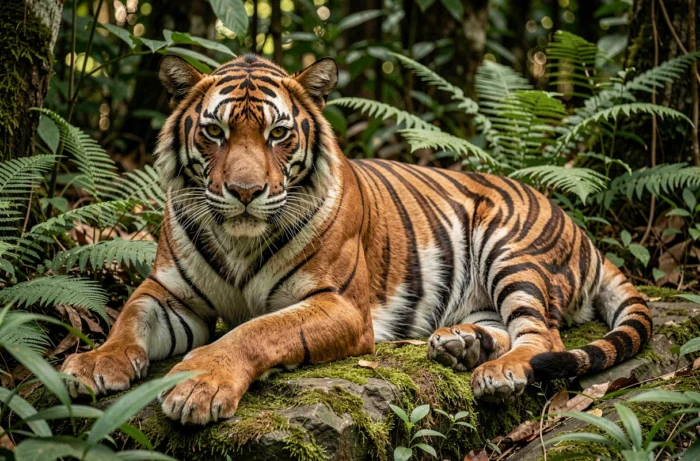
On the planet, species classified as critically endangered often share a profile: restricted habitat, slow reproduction, sensitivity to pollutants. The Bengal tiger, for example, faces land pressure, poaching, and reduction of its forest territory.
Conservation Status in France: What the 2019-2024 Assessment Reveals
The European regulatory assessment, conducted in France under the auspices of the Ministry of Ecological Transition, produces a report every six years. The results for 2019-2024 are unequivocal:
- 67% of assessments of remarkable species and habitats are unfavorable, meaning that the majority of the evaluated environments and species do not meet the criteria for good conservation status
- 39% of assessments show a declining trend, compared to a stable or improving proportion for the rest
- Coastal, wet, and aquatic environments concentrate the most degraded situations, with cumulative pressures (urbanization, diffuse pollution, invasive exotic species)
These data only cover so-called “remarkable” species and habitats, those listed by the European Habitats and Birds directives. Ordinary biodiversity (pollinator insects, common passerines, soil microfauna) largely escapes this monitoring.
Declining Migratory Birds: A Global Warning Signal
Nearly half of migratory bird species are in decline worldwide, according to data reported by Le Monde in September 2026. This figure is striking because migratory birds cross entire continents: their decline reflects the simultaneous degradation of several habitats along their migration routes.
In France, there are observed shifts in spring arrivals, declining numbers at certain migratory stopovers, and changes in routes. A struggling migratory bird signals a problem across an entire geographical corridor, not just within one country.
Reproduction and Conservation: Concrete Levers
Natural reserves and special protection areas play a direct role in the reproduction of breeding species. When we protect a reed bed, we provide a nesting site for reed warblers, bitterns, and purple herons.
Conservation programs are not limited to passive protection. They include hydraulic management of water levels, control of introduced predators, and monitoring through ringing or geolocation. Returns vary on this point depending on species and sites, but actively managed areas generally show better results than simply designated areas.
Recent Species Discoveries: Proof That the Inventory Is Not Closed
Alongside the decline, new species continue to be described each year. In the Amazon, the filming of a documentary led to the discovery of a new species of anaconda, a snake whose size and genetics clearly distinguish it from already known species.
Each newly described species reminds us of the extent of what we still do not know. Tropical forests, seabeds, and even temperate soils harbor organisms that have never been inventoried. The natural history of the planet is still being written.
This tension between massive decline and sporadic discoveries summarizes the current state of the animal world. We are losing populations at a documented rate while realizing that the catalog of life remains incomplete. The priority on the ground remains the same: protect functional habitats before the species they harbor, known or unknown, cross the threshold of irreversible decline.