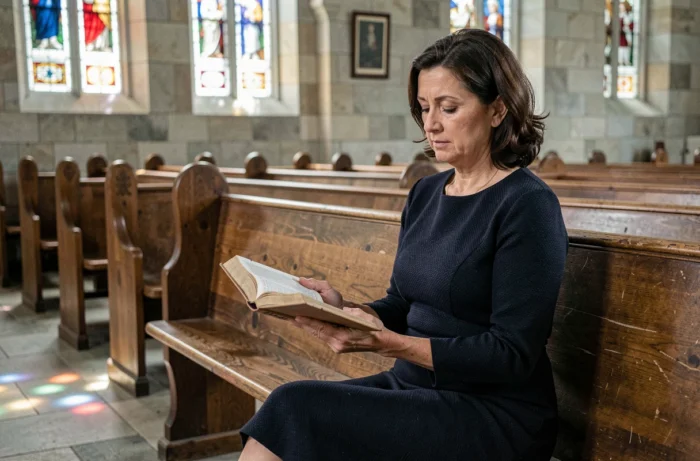
A funeral ceremony typically includes three to five pieces of music, spread across specific moments: welcome, reflection, final farewell, exit. The choice of these pieces is not based on musical taste in the usual sense. It is about creating a coherent emotional progression that accompanies the loved ones from the beginning to the end of the ceremony.
Musical pre-programming: anticipating the proceedings before the urgency of grief
The majority of families choose the music in the days following the death, under the pressure of the calendar. This constraint often leads to default choices, dictated more by panic than by reflection.
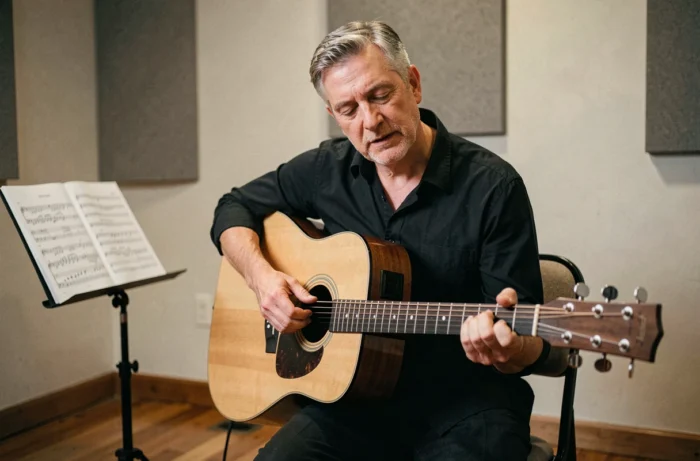
A practice that is still little documented is gaining ground: the pre-programming of the complete musical proceedings. The principle consists of deciding, while alive, not only on a few favored titles but also on the precise arrangement of the pieces according to the moments of the ceremony. This discussion can take place with a celebrant, a funeral advisor, or simply be recorded in a personal document.
The main advantage is narrative coherence. When a person chooses the alternation between a liturgical passage and a popular song, between a moment of instrumental reflection and a brighter piece for the exit, the result forms an emotional arc that the loved ones would have found difficult to reconstruct in urgency. Choosing farewell songs for a funeral in advance transforms what is often experienced as an administrative chore into a personal gesture, full of meaning.
Religious or civil ceremony: real constraints on the choice of pieces
The location and type of ceremony set a framework that families often underestimate. In a Catholic church, the celebrant may refuse certain pieces deemed incompatible with the sacred nature of the place. The Church’s regular reminders on this point show that the liturgy imposes precise limits on the authorized repertoire.
In practice, psalms, offertory hymns, and resurrection hymns form the foundation of a religious ceremony. Families wishing to incorporate personal titles (French songs, film music) must negotiate their placement, often at the time of entry or exit, outside of strict liturgical times.
The civil ceremony opens a free field
At the crematorium or in a secular ceremony hall, no repertoire restrictions apply. It is in this context that the greatest diversity is observed: instrumental pieces by Hans Zimmer or John Williams, pop titles, songs in foreign languages. This normalization of film and pop music in funeral rituals reflects an evolution in families’ relationship to the ceremony, which becomes more of a sound portrait of the deceased than a codified rite.
The point of vigilance remains the duration. An orchestral piece of seven or eight minutes can disrupt the proceedings. Checking the exact length of each title before the ceremony avoids awkward silences or abrupt cuts.
Building the emotional progression of a ceremony with music
The most common pitfall is choosing only sad pieces. A ceremony composed of five melancholic titles creates an emotional saturation that hinders reflection instead of fostering it.
Each moment of the ceremony calls for a different tone:
- The welcome requires a sober piece, preferably instrumental, that establishes inner silence without causing immediate collapse.
- The tribute time supports a more personal title, with lyrics, that directly evokes the life or personality of the deceased.
- The final farewell is the most intense moment. A stripped-down piece (solo voice, piano, cello) works better than a massive orchestration.
- The exit benefits from being carried by a brighter title, sometimes even a piece that the deceased loved to listen to in daily life, so that the loved ones leave the room with a memory of life rather than a final image of mourning.
This alternation between restraint and emotion, between gravity and gentleness, is what distinguishes a memorable ceremony from a simple sequence of titles.
Lyrics of funeral songs: what the text really says matters
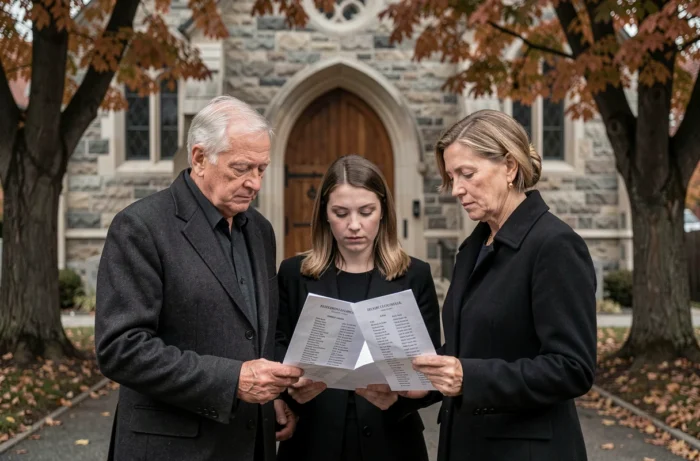
Many families choose a title for its melody without carefully reading the lyrics. A piece whose text evokes a breakup or a context unrelated to grief can create a disconnect perceived by the assembly, even if the melody seems appropriate.
Reading the lyrics aloud before validating a title remains the most reliable method. Certain lines that go unnoticed when listening take on particular significance in the silence of a ceremony. A misplaced word, an ambiguous image, and the reflection breaks.
Instrumental pieces: an underestimated alternative
Pieces without lyrics (classical, film scores, solo piano compositions) avoid this risk. They allow each person present to project their own memories onto the music. Pachelbel’s Canon in D, Barber’s Adagio for Strings, or some compositions by Ludovico Einaudi are regularly chosen for this reason: the absence of text universalizes the emotion.
For a tribute to a mother, father, or child, an instrumental piece associated with a text read by a loved one often produces a more powerful effect than a song with lyrics played alone. The living human voice, even trembling, anchors the moment in reality.
Technical aspects to check before the ceremony
A final point, often overlooked, concerns the quality of playback. The audio systems of crematoriums and churches vary significantly. A low-quality compressed file, an unstable Bluetooth connection, or a scratched CD can turn a solemn moment into a technical incident.
- Provide the files in uncompressed format (WAV or FLAC) on a USB stick, in addition to a backup solution (phone with jack cable).
- Test the volume and sound quality on-site if the venue allows, ideally the day before.
- Prepare the exact order of the pieces in a written document given to the technician or celebrant, with precise durations.
The choice of pieces represents the emotional dimension. Technical preparation ensures that this emotion reaches the loved ones intact. A perfectly chosen title, poorly played, loses half of its impact.