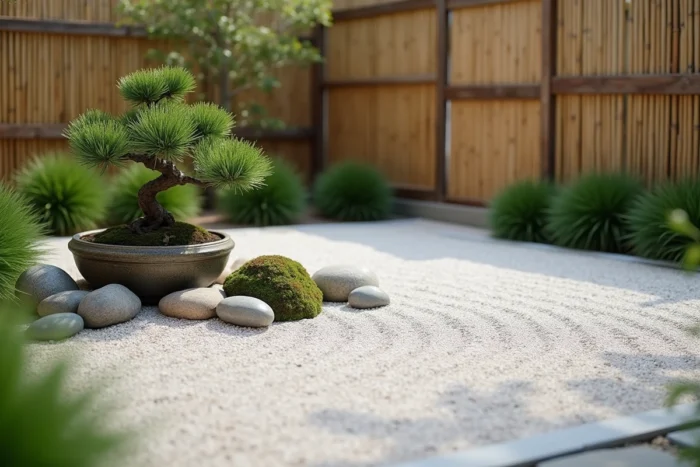
The zen garden relies on prior work on the land itself: slope, exposure, soil type, prevailing winds. Behind the apparent simplicity of these Japanese-inspired compositions, success depends on this attentive reading of the site, well before the choice of materials or plants.
Site Analysis Before Creating a Zen Garden
The recent trend in zen garden projects is to treat the layout as a true adaptation to the terrain, rather than just a decorative staging. Landscape professionals now offer 2D or 3D plans before any execution, incorporating analysis of the slope, microclimate, and soil quality.
A sloped terrain, an embankment, a small urban courtyard, or a rooftop terrace are not treated the same way. In each case, the choice of materials, drainage system, and plant selection change radically. For example, light gravel laid on clay soil without geotextile will be overrun by weeds in a few months.
Before buying any bags of sand or stones, it is useful to note the solar orientation of the plot, the shaded areas throughout the day, and the wind corridors. This data conditions the placement of stones, plants, and resting areas. To deepen your outdoor design ideas, you can visit the Jardin Jade website which offers resources on the subject.
Zen Garden and Local Regulations: A Point to Check in Advance
Urban planning regulations can block a zen garden project if they are not consulted from the start. The installation of a fixed structure (pergola, tea pavilion, decorative fence, masonry fountain) in a private garden may require a prior declaration of works, depending on local rules and the local urban plan.
Thresholds vary from one municipality to another. A covered structure, even a light one, sometimes exceeds the authorized limits without formalities. Checking with the urban planning department of your town hall before starting work avoids costly setbacks, including the obligation to dismantle.
Any fixed construction in a garden may require permission, including elements that are purely decorative. This point of vigilance also concerns bamboo fences if they exceed a certain height or buried basins beyond a certain volume.
Mineral and Plant Composition for a Sustainable Zen Space
The zen garden rests on a balance between mineral and plant elements. Sand and gravel form the base, stones structure the space, and plants bring life without cluttering the composition. The difficulty lies in the dosage.
Sand, Gravel, and Stones: The Foundation of the Garden
Light sand or finely raked gravel constitutes the characteristic soil of karesansui. This covering facilitates drainage, limits mowing maintenance, and adapts well to dry climates. Laying a geotextile under the gravel remains the basic precaution to slow down the growth of weeds.
The stones play a role in vertical structuring. Varying sizes and textures while maintaining a consistent color tone creates visual coherence. Asymmetry and odd numbers (three stones, five stones) are principles derived from Japanese tradition that produce a natural rather than geometric effect.
Plants Suitable for the Zen Garden: Favor Low Maintenance
The most noticeable trend in recent years associates zen aesthetics with a logic of low maintenance and reduced watering. The choice leans towards evergreen plants, ground covers, and simple compositions that do not require frequent pruning or intensive watering.
Among the plants that appear in successful zen compositions:
- Japanese maples (atropurpureum varieties), which grow between three and five meters and provide verticality at the back of the garden
- Low grasses like hakonechloa, which sway in the wind and enhance the calming atmosphere without invading the space
- Mosses and heathers as ground cover, which dress the bases of stones and reduce the area to weed
- Cloud-pruned pines (niwaki), which serve as focal points but require years of formative pruning
A sustainable zen garden relies on plants adapted to the local climate, not on an idealized list. A Japanese maple will suffer in full Mediterranean sun without shade, while a heather will thrive in acidic soil but decline in limestone.
Water and Sound Ambiance in a Zen Garden
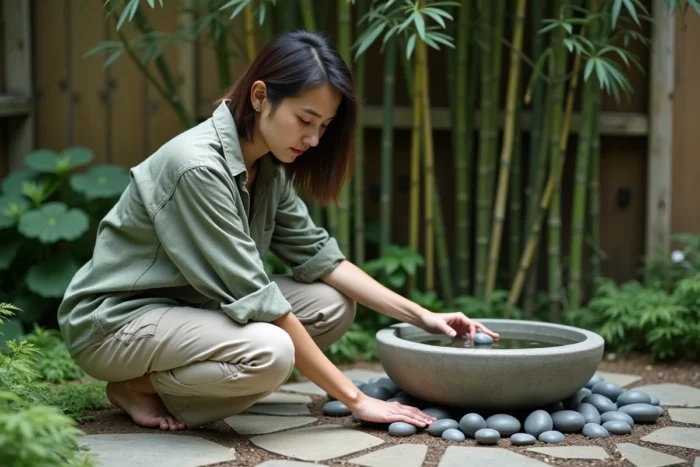
Water is not just a decorative element in a Japanese garden. It brings a sound dimension that transforms the experience of the place. A trickle of water flowing over a stone, a small basin with a few water lilies, or a tsukubai (traditional low basin) is enough to create this presence.
Pump-free solutions exist for small spaces: a manually fed basin, a rainwater collector integrated into the composition. For a basin with a pump, it is necessary to plan for a buried electrical supply that meets standards, which brings us back to the question of the prior declaration mentioned earlier if the basin exceeds a certain volume.
Water brings the sound dimension that distinguishes a zen garden from a mere mineral decor. Without it, the composition remains silent and loses part of its calming effect.
Realistic Maintenance of a Zen Garden Through the Seasons
The zen garden is often seen as a maintenance-free space. Gravel gets dirty, dead leaves accumulate in the crevices, and mosses turn brown in dry summer. Regular raking of the sand, a theoretically meditative gesture, becomes a chore if the surface is too large or poorly protected from the wind.
Some points to anticipate from the design stage:
- Plan for borders to contain the gravel and prevent it from migrating onto the lawn or pathways
- Limit the raked sand area to what can be maintained in a few minutes
- Choose local stones that do not stain with the limestone from watering
Sizing each element to what can realistically be maintained over time remains the basis of successful design. Gravel, mosses, and raked surfaces each require a specific seasonal action, and planning for this from the initial design avoids abandonment after two years.