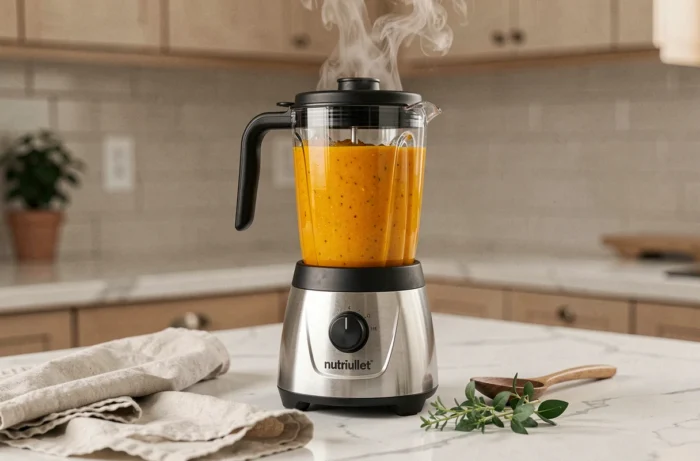
The NutriBullet is not a heating blender. This is a point that many buyers discover afterward, and it conditions the rest of the analysis. No model in the range has a built-in heating element to cook raw vegetables directly in the bowl. The confusion comes from marketing, which highlights soup recipes without specifying that the heating relies on the friction of the blades or on external pre-cooking.
NutriBullet Motor Power and Hot Blending Capacity
The NutriBullet range features powers ranging from 600 to 1700 watts depending on the models. These figures, omnipresent on the packaging, deserve to be put into perspective. The advertised power does not always correspond to the actual power delivered to the blades, a discrepancy documented across several references of the brand.
A 900 W motor (Pro range) is sufficient to crush cooked vegetables and achieve a smooth velouté in just a few seconds. However, blending raw and hard vegetables (butternut, celeriac) in the hope that friction will heat the preparation remains a dead end. The temperature rise through friction does not exceed a lukewarm state, far from the 70-80 °C required for a hot soup.
We observe that the confusion between “hot blending” and “cooking” persists in most online reviews. Blending a pre-cooked soup in a NutriBullet works perfectly. Asking it to replace a heating blender with a heating element does not.
To delve deeper into this point, a detailed test examines whether the NutriBullet for soup truly lives up to its promises compared to devices designed to cook and blend simultaneously.
NutriBullet Combo: The Game-Changing Format for Soups
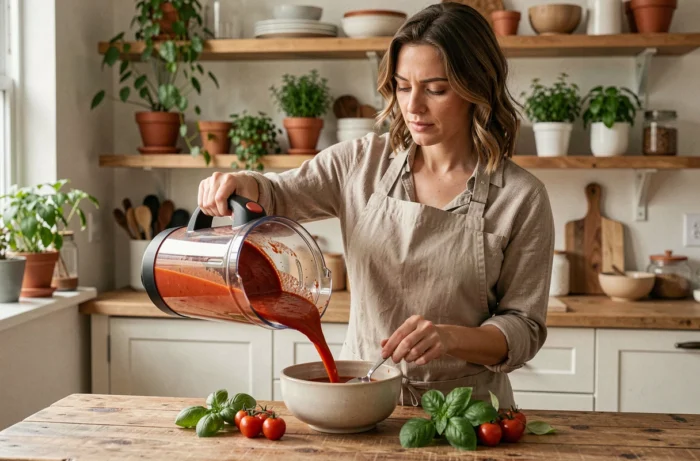
The recent trend at NutriBullet is not towards a dedicated soup maker. The brand promotes its combo models, notably the Nutribullet Combo NBF500MB, which combines a 1.9-liter family bowl and an individual cup on the same base. The idea is to cover two uses (soup in quantity in the evening, on-the-go smoothie in the morning) without multiplying devices on the countertop.
This 2-in-1 positioning meets a real demand. A household that prepares soup in a blender once or twice a week does not need a dedicated Moulinex Soup&Co. The combo allows cooking vegetables in a pot or steamer, then transferring them to the NutriBullet bowl for quick blending.
The Concrete Limits of the Combo Format for Soup
The 1.9 L bowl cannot be filled to the brim with a hot preparation. The expansion of steam and the risk of splatter require filling only up to two-thirds, resulting in a usable volume of about 1.2 L. For a couple, this is sufficient. For a family of four, blending must be done in two batches.
The lid seal can handle warm to hot liquids, but pouring a broth over 80 °C directly into the Tritan plastic bowl is not recommended. Allowing the preparation to cool for a few minutes before blending avoids any deformation of the bowl and reduces internal pressure.
Dedicated Heating Blender or NutriBullet: Technical Choice Criteria
The real divide does not concern blending power, where NutriBullet holds its own, but on three specific points:
- The presence or absence of a built-in heating element in the bowl, which allows cooking raw vegetables without pre-cooking. Moulinex, Philips, or Russell Hobbs heating blenders incorporate this function. No NutriBullet offers it.
- The material of the bowl: borosilicate glass for most heating blenders (high thermal resistance, dishwasher safe) versus Tritan or copolyester for NutriBullet. Glass withstands thermal shocks, while plastic requires precautions.
- The automatic cooking and blending programs. A heating blender generally offers pre-programmed cycles (pureed soup, chunky soup, compote) with automatic management of temperature and duration. The NutriBullet operates in manual mode: you press, it blends, you release.
When the NutriBullet Remains the Best Choice
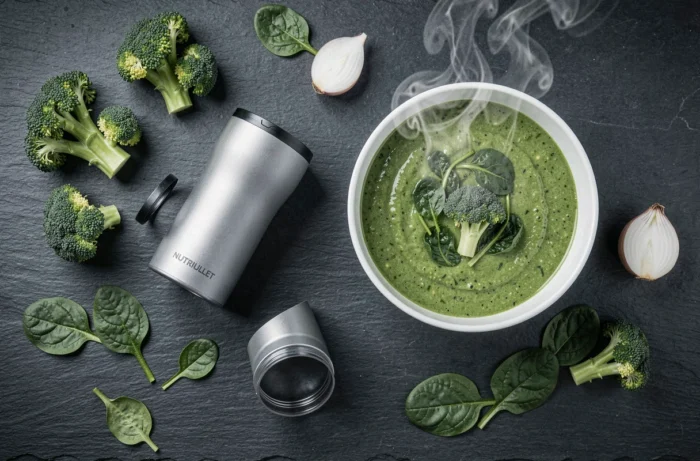
For use focused on smoothies, baby purees, and occasional soups made from already cooked vegetables, the NutriBullet offers a space-to-performance ratio that is hard to beat. Its compact format, quick cleaning of individual cups, and grinding quality on soft ingredients make it an effective everyday appliance.
We recommend the NutriBullet to those who already have a cooking method (pot, pressure cooker, Thermomix) and are looking for a finishing device to smooth their soups. The space-saving compared to a heating blender with a glass bowl is significant.
Cleaning and Durability of the NutriBullet in Soup Use
Cleaning is a frequently cited argument in favor of the NutriBullet, and it holds true in practice. The cups rinse under hot water in a few seconds after a smoothie. After a soup, it’s less straightforward. Residues from fibrous vegetables (leeks, celery) cling around the base of the blades and require scrubbing.
The blade base is not removable on all models, which complicates deep cleaning. On the Pro and Ultra models, the trick is to fill the cup with soapy hot water and run a short cycle. This dislodges most residues, but a brush is still needed for stubborn fibers.
In terms of durability, the seals are the main wear parts. Frequent use with hot preparations accelerates their aging. Replacement seals are available, but their reference varies by generation of NutriBullet.
The NutriBullet does very well what it was designed for: quickly blending ingredients in a compact format. Asking it to replace a heating blender is like asking a screwdriver to act as a drill. The tool works, but not for that job.