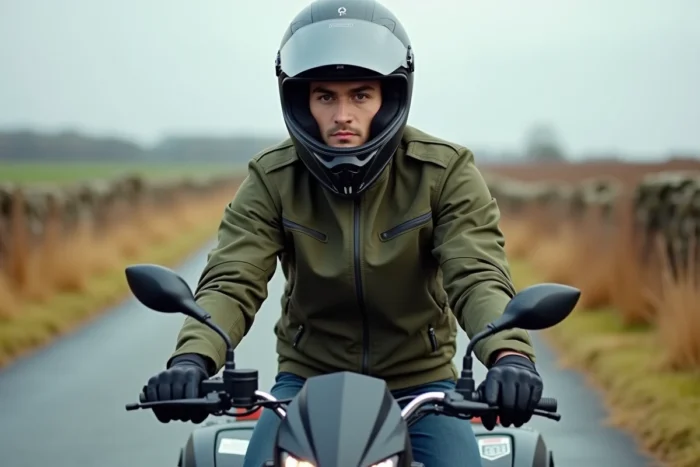
A 125 cm³ road-legal quad looks like any other quad in an advertisement. Four wheels, a handlebar, an engine. The difference lies in an administrative detail that many beginners discover too late: the category listed on the registration document. This is what determines the required license, the insurance rate, and even the right to ride on public roads.
Category L6e or L7e on the registration document: what it changes in daily life
Before comparing brands or suspensions, it’s important to understand a simple technical point. A homologated 125 quad can be classified into two different categories: L6e (light quadricycle) or L7e (heavy quadricycle). This classification appears on the registration document, in field J1.
A L6e quad is limited to 45 km/h. It can be driven from the age of 14 with an AM license (formerly BSR). An L7e quad can exceed this speed, but its power remains capped at 15 kW. It requires at least a B license or an A1 license.
Why does this detail matter so much? Because an insurer checks the correspondence between the vehicle’s category and the driver’s license. If you buy a used L7e quad thinking that an AM license is sufficient, the insurer may refuse coverage in the event of a claim. The vehicle would then be driven without valid insurance, with the financial and legal consequences that entails.
To fully understand these stakes before a purchase, it is useful to know everything about the homologated 125 quad and the obligations that come with it.
Used 125 quad: concrete checks before signing
The used market is full of 125 quads with unclear administrative histories. A vehicle may have been derestricted, imported without French homologation, or modified in a way that no longer corresponds to its original category. Here are the checks to carry out before pulling out your checkbook.
- Request the original registration document and read field J1 (category) and field P.1 (cylinder capacity). If the indicated category is L7e, ensure that you have the corresponding license. If the seller cannot provide the registration document, move on.
- Check that the serial number engraved on the chassis matches the one listed on the registration document. A discrepancy indicates a disguised vehicle or one assembled from parts of different origins, which renders the homologation void.
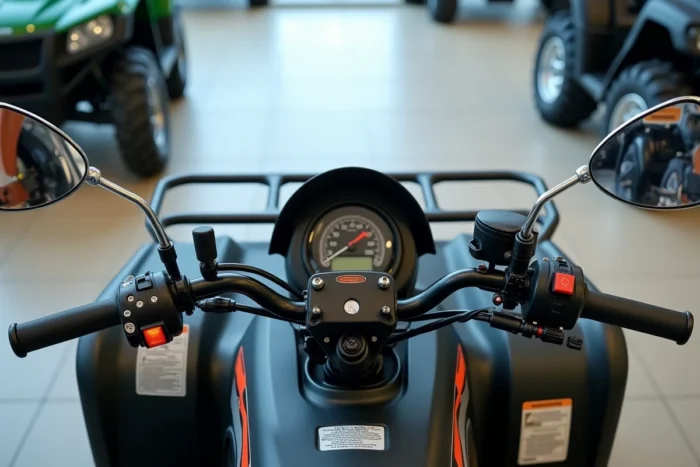
- Inspect the manufacturer’s plate (often attached to the frame near the handlebar). It mentions the applicable pollution standard. Quads compliant with Euro 5+ have more recent standard equipment, such as LED lighting or an onboard diagnostic system.
- Request an up-to-date certificate of non-encumbrance. A quad under opposition cannot be registered or insured in your name.
These checks take about ten minutes. They prevent immobilization by law enforcement or an insurance refusal that would leave you without recourse after an accident.
Homologated 125 quad: mechanical criteria not to overlook
Once the administrative part is settled, the mechanics come into play. On a 125 quad, the engine is generally a single-cylinder four-stroke. Reliability depends less on the brand than on the actual maintenance performed.
Transmission and cooling
Two types of transmission coexist: chain and shaft. The chain requires regular lubrication and periodic replacement. The shaft is more durable but costs more to repair in case of breakage. For mixed use (road and trails), the shaft significantly reduces routine maintenance.
Cooling is another often-overlooked criterion. An air-cooled engine is sufficient for short trips at moderate speeds. A liquid-cooled engine tolerates prolonged loads better, such as a slow climb on steep terrain.
Suspensions and braking
The front suspensions are generally triangular arms with adjustable shock absorbers. At the rear, there is either a mono-shock or a rigid axle depending on the positioning of the quad (leisure or utility). Test the travel at a standstill: a shock absorber that doesn’t return properly indicates an oil leak.
Hydraulic disc braking on all four wheels is a minimum for road use. Some entry-level models still retain a drum brake at the rear, which significantly increases the stopping distance on wet asphalt.
License, insurance, and equipment for riding a 125 quad
You have found the right quad, the registration document is in order, and the mechanics are sound. Now comes the legal part, often underestimated by first-time buyers.
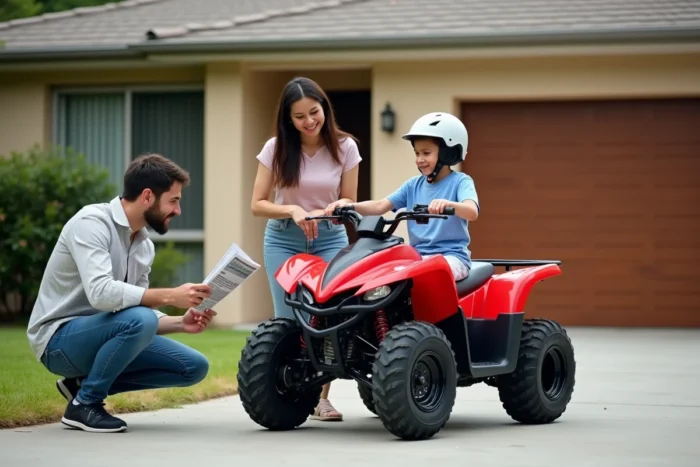
The B license allows you to drive any L7e quad. The A1 license (available from the age of 16) also works. For a L6e quad limited to 45 km/h, the AM license is sufficient from the age of 14. Check the category of the quad before contacting the insurer, as the premium and coverage vary significantly between an L6e and an L7e.
Regarding mandatory equipment, wearing an approved helmet applies to all occupants. CE-certified gloves are also required. The quad itself must be equipped with mirrors, turn signals, and compliant lighting.
A point rarely mentioned in guides: the implementation of the Euro 5+ standard has pushed manufacturers to revise the 125 cm³ offering. Recent models come standard with components that facilitate passing a potential technical inspection, which is being clarified for two-wheelers and quadricycles. Buying a quad compliant with this standard, even used, simplifies future procedures.
Ultimately, the choice of a homologated 125 quad rests on three pillars: the correct administrative category (L6e or L7e) according to your license, a thorough verification of the mechanical and documentary condition in the used market, and insurance suited to the actual category of the vehicle. A well-prepared purchase on these three axes avoids most of the disappointments reported by owners.