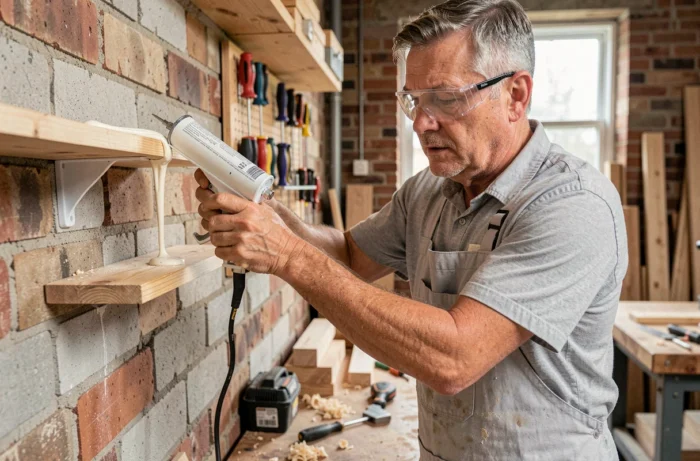
Fixing baseboards to a plaster wall without drilling, reattaching a detached door frame after a bump, hanging a heavy mirror on tiles: these common DIY situations require a reliable mounting adhesive. Pattex Montage Classic often comes up in discussions among DIY enthusiasts for its claimed versatility. We took a close look at what this product really offers, its concrete limitations, and the situations where it’s better to look elsewhere.
Materials incompatible with Pattex Montage Classic: what the technical data sheet specifies
Before even discussing performance, the first thing to check on a mounting adhesive is the list of excluded materials. On this point, merchant sheets often remain vague by emphasizing the “all materials” aspect.
Recent technical sheets for Pattex mounting adhesives, however, indicate clear exclusions. Polyethylene, polypropylene, and PTFE are not compatible. Soft PVC, copper, and brass are also among the excluded surfaces according to the references.
In practice, this means that a soft PVC gutter pipe, a polypropylene storage bin, or a Teflon seal will not adhere properly, even with careful preparation. We’ve read our share of disappointed feedback on forums where the issue was simply an unsuitable material, not a defect in the product.
To avoid any unpleasant surprises, we recommend reading our review of Pattex Montage Classic adhesive that details these compatibilities before purchase.
Outdoor resistance and temperature range: Pattex Montage adhesive in real conditions
A common use for mounting adhesives involves outdoor fixations: house number on a pillar, shelf under a canopy, fixing paneling to a covered terrace wall. The question of durability against humidity and temperature fluctuations arises.
Recent Pattex mounting products positioned as “all materials” or “heavy objects” are described as water-resistant, weatherproof, and resistant to temperature variations. The stated range goes from -30 °C to +80 °C, which covers most situations in metropolitan climates.
On the ground, feedback varies on this point. An outdoor bond exposed directly to UV and heavy rain ages less well than a fixation under shelter. Water resistance does not mean prolonged immersion. For use in humid areas (bathroom, laundry room), performance remains acceptable as long as the surface is clean and dry at the time of application.
Drying and initial setting according to the season
Drying time varies significantly with ambient temperature. In summer, the initial setting is faster. In winter, in an unheated garage, a longer hold time is required before releasing pressure.
Keeping the bonded piece under pressure during the initial setting remains the most determining condition for a solid result, regardless of the season. Wide masking tape or light clamps work well for lightweight pieces.
Application and surface preparation: mistakes that ruin adhesion
The majority of bonding failures do not come from the adhesive itself but from preparation. Here are the points that make the difference between a durable fixation and a detachment after a few weeks:
- Dust and degrease both surfaces with a clean cloth and isopropyl alcohol. A freshly painted wall that seems clean often carries an invisible greasy film.
- On porous substrates (plaster, raw wood, cellular concrete), apply the adhesive in thick beads rather than fine lines. The substrate absorbs part of the product, so compensation is necessary.
- On smooth and non-porous substrates (tiles, glass, compatible metal), a thin zigzag bead is sufficient. Press firmly for several seconds to expel air bubbles.
- Never apply to a damp or frosted surface. Even a thin film of moisture prevents proper adhesion.
Cleaning up excess is easy as long as the adhesive is fresh, with a damp cloth. Once dry, the adhesive can only be removed by mechanical scraping, which may damage fragile surfaces.
Hybrid polymers or neoprene: which formula in Pattex Montage Classic
For several years, Pattex has been directing its mounting range towards hybrid polymer-based formulas rather than classic neoprene compositions. This technical distinction has direct consequences on usage.
Hybrid polymer formulas emit less odor, contain fewer solvents, and allow bonding to more substrates, including some rigid plastics and expanded polystyrene (which neoprene attacks). The absence of aggressive solvents makes these formulas more suitable for indoor use, especially in poorly ventilated rooms.
In contrast, neoprene adhesives often offer a faster initial setting and superior shear resistance on assemblies subjected to lateral forces. To fix a heavy object that experiences vibrations (a shelf near a regularly slammed door, for example), the neoprene formula retains an advantage.
Which product to choose according to the project
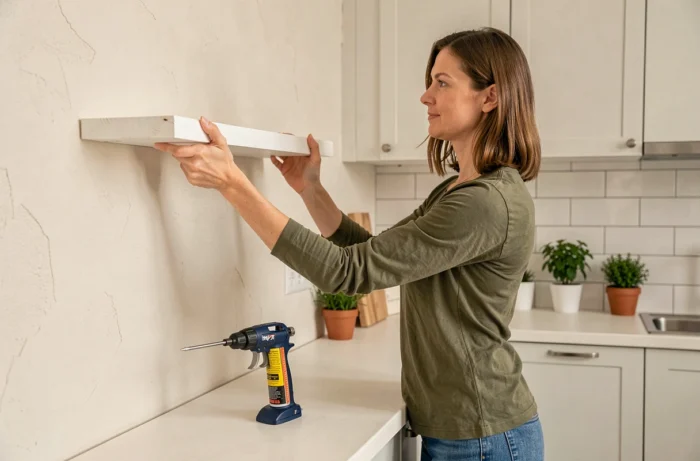
For classic indoor bonding (baseboards, moldings, decorative elements, mirrors), the hybrid polymer formula is perfectly suitable. For outdoor bonding subjected to mechanical constraints or requiring a quick set, checking for the “neoprene” or “contact” mention on the packaging remains the right approach.
Pattex Montage Classic positions itself in the versatile segment. It does not replace a structural adhesive for load-bearing assemblies, but it covers the vast majority of common household fixations without drilling. Identifying the material, preparing the surface correctly, and respecting the setting time: these three points matter more than the choice between two similar references on the shelf.