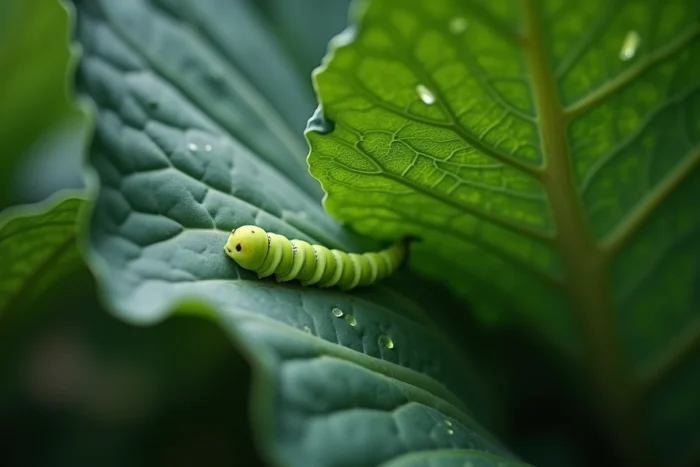
The small green caterpillars that nibble on the leaves of cabbages, tomatoes, or salads belong to various butterfly species, mainly noctuids and pierids. Their presence in the vegetable garden is not an accident: it reflects a normal biological cycle where adult butterflies lay their eggs directly on the plants that the larvae will feed on. The problem begins when the populations exceed a threshold where the damage seriously threatens the harvest.
Threshold of pestiness for green caterpillars: intervene or tolerate
Organic gardening networks emphasize a point that most general public guides overlook: not all caterpillars in the vegetable garden warrant intervention. Naturalist associations remind us that the majority of garden caterpillars are not pests, and many feed on a single host plant in limited quantities.
Before treating, one must observe. A few holes in the outer leaves of a cabbage do not compromise the head. A vigorous tomato plant can withstand the loss of a few lower leaves without affecting the fruits. The “zero caterpillar” approach is not only unrealistic but counterproductive: it leads to repeated treatments that also disrupt beneficial insects and pollinators.
The idea is to adopt a logic of threshold of pestiness: only act when the caterpillar population concretely threatens the harvest. This reasoning changes the way to manage the vegetable garden, shifting from systematic reaction to a strategy that combines regular observation, partial tolerance, and targeted intervention.
To fight against small green caterpillars in the vegetable garden, encouraging natural predators remains the first line of defense before any treatment, even biological.

Natural predators of caterpillars in the vegetable garden: birds, wasps, and ground beetles
A vegetable garden that hosts a diverse fauna self-regulates a good part of its caterpillar populations. For example, great tits consume considerable amounts of larvae to feed their broods in spring, exactly when the first eggs hatch on the vegetables.
Parasitoid wasps (trichogramma, braconids) lay their eggs directly in the eggs or caterpillars of noctuids. Their action goes unnoticed, but it reduces populations well before the damage becomes visible. Ground beetles, those dark beetles that move on the ground at night, are also formidable predators of young caterpillars.
Concrete arrangements to attract these auxiliaries
- Install nesting boxes for great tits (28 mm entrance hole) near the vegetable garden, facing east or southeast, before March so that the pairs settle in before the butterfly laying season.
- Leave areas of spontaneous vegetation (nettles, grasses) at the edge of the plot: they host beneficial insects and provide refuge for ground beetles during the day.
- Maintain a thick organic mulch at the base of crops, which creates a moist habitat favorable to soil predators and also limits the laying of certain butterfly species.
An overly “clean” garden lacks natural predators. Hedges, wood piles, and flowering strips are not just decorative: they constitute the infrastructure that allows biological regulation to function.
Bacillus thuringiensis in the vegetable garden: mode of action and real limits
When observation confirms a genuinely harmful caterpillar population, Bacillus thuringiensis var. kurstaki (Bt) remains the reference biological treatment. This bacterium, sprayed on the foliage, produces a toxin that destroys the digestive system of lepidopteran caterpillars after ingestion. Bt only acts on the caterpillars that eat the treated leaves, making it very selective compared to a conventional insecticide.
Its effectiveness depends on specific conditions. The bacterium degrades quickly under ultraviolet light: a spray in full sun loses most of its activity within a few hours. Treatments should be done at the end of the day and repeated after each rain. Young caterpillars are much more sensitive to it than older larvae, which requires monitoring of the egg-laying and early intervention.
What Bt does not do
Bt does not distinguish between cabbage white caterpillars and those of the swallowtail (a protected butterfly that lays on fennel and dill). Any spraying of Bt indiscriminately eliminates all butterfly caterpillars present. In a vegetable garden that combines vegetables and herbs, the treatment may affect species that one would like to preserve.
Field reports vary on the actual duration of Bt’s effectiveness under cultivation conditions. Some gardeners report a clear action in two or three days, while others find disappointing results, often linked to poor timing or application on caterpillars that are already too developed.
Insect nets and crop rotation: mechanical prevention
Prevention is more effective than curative control. Fine mesh insect nets, placed on hoops above sensitive crops (cabbages, broccoli, salads), physically prevent adult butterflies from laying eggs on the leaves. This is the most reliable method for brassicas, which massively attract pierids.
The net must be placed as soon as planting occurs, without waiting for the first butterfly flights. A late installation sometimes traps already present eggs on the plants, making the protection useless. It is also necessary to check that the edges are well pressed to the ground, as butterflies exploit the slightest opening.
Crop rotation plays a complementary role. By changing the location of cabbages and solanaceous plants each year, we disrupt the cycle of species whose chrysalises overwinter in the soil near former plantings. This is not a miracle solution, but combined with nets and plant diversity, it gradually reduces pest pressure.
Companion plants: variable results
The association of aromatic plants (sage, thyme, mint) with sensitive crops is often cited as a repellent against caterpillars. The available data do not allow for a conclusion on a significant effectiveness of these associations on noctuid or pierid populations. However, they contribute to the plant diversity of the vegetable garden, which indirectly favors beneficials.
Managing small green caterpillars relies on a balance between tolerance, mechanical prevention, and occasional treatment. Observe before acting, encourage predators, place nets on the most exposed crops: these three reflexes cover the vast majority of situations in the vegetable garden without resorting to products, even biological ones.