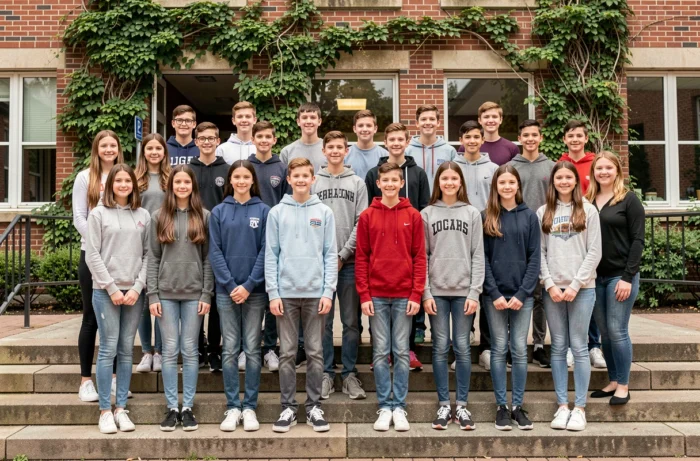
Class photos taken at a Jean Rostand middle school are hosted on platforms that vary depending on the affiliated academy. Accessing these pictures securely requires understanding the technical distribution circuit, the applicable consent rules, and the precautions to take once the image is downloaded.
ENT Authentication: the technical lock before any consultation
Each Jean Rostand middle school is affiliated with an academy, and each academy imposes its own digital work environment (ENT). The school in Sainte-Jamme-sur-Sarthe uses e-lyco, the one in Nîmes uses mon-ent-occitanie, and the one in Craponne publishes via LaClasse blogs. Class photos, school trip pictures, or educational project images are transmitted through these platforms, often behind authentication reserved for registered families and students.
The EduConnect system centralizes access for legal representatives and students. Account activation can be done either through self-registration with a mobile phone number, via FranceConnect, or with the help of the school’s administration. Once logged in, the document space or the school’s internal blog provides access to the photo galleries published by the educational team.
Finding the class photos of the Jean Rostand middle school thus first requires this digital identification, which ensures that only authorized individuals can view the pictures.

Image rights authorization: what the school requires before distribution
Photography in a school setting and its online publication are subject to two distinct authorizations. The first concerns the right to photograph the student. The second pertains to the distribution of the image, whether on the ENT, the school’s website, or an online ordering service like those offered by some school photographers.
At the beginning of the school year, the institution has legal representatives sign a form specifying the authorized media (website, brochure, internal network). A refusal to publish does not prevent the photograph from being taken, but prohibits publication on any medium accessible to third parties. The concerned student will not appear in the online galleries, even those protected by a password.
Concrete consequences of a partial refusal
A parent may authorize distribution on the ENT (restricted access) while refusing publication on the school’s public site. The school photographer and the administration must then manage two parallel distribution circuits, which sometimes explains longer delays before the class photos are published online.
Law of February 19, 2024: strengthened obligations for families
The law no. 2024-120 of February 19, 2024 has modified the legal framework for the distribution of images of minors. This law requires parents to involve the child, depending on their age and maturity, in decisions regarding the publication of their image. The text directly targets situations where a class photo, initially viewed in a secure space, is later shared on a public social network.
The practical consequences for the families of a middle school student are as follows:
- Before republishing a class photo on a personal account, one must obtain the consent of their own child and verify that the other visible students (or their parents) have not refused distribution.
- Sharing in a private messaging group (WhatsApp, Signal) remains tolerated, but redistributing to a public space exposes one to liability based on image rights.
- A student in the eighth or ninth grade can legitimately oppose their parents publishing their class photo, and this opposition now has an explicit legal basis.
This legislative change alters the notion of “security” surrounding school photos. Accessing the photo is only the first step; redistributing it engages parental responsibility.
Online ordering of school photos: typical process and points of vigilance
Several Jean Rostand middle schools use specialized providers for the sale of class photos. The usual process involves a unique code distributed to each student, allowing access to a secure online store. This code is personal and should not be shared outside the household.
Verify the authenticity of the ordering site
Phishing attempts regularly exploit the theme of school photos. Before entering banking details, three reflexes can help limit the risk:
- Check that the URL of the ordering site exactly matches that indicated in the letter or email sent by the institution.
- Verify the presence of the HTTPS protocol and a valid certificate (padlock in the address bar).
- Never click on a link received via SMS or unofficial messaging claiming to provide access to class photos.
Payment is generally made by credit card or, in some institutions, by check addressed to the social-educational center (FSE) that manages the relationship with the photographer.
Delays and complaints
Photos ordered online are delivered to the school and then handed to the student. The delay varies depending on the provider but rarely exceeds a few weeks after the order deadline. In case of issues (missing photo, printing error), complaints should go through the school’s administration, which will relay them to the photographer.
Former students: finding class photos after schooling
Once schooling is completed, access to the ENT is deactivated. Class photos published on these spaces are no longer accessible unless the institution has also uploaded them to its public site (which depends on the image rights authorizations collected).
Facebook groups or alumni associations sometimes serve as a relay, but distribution there escapes the secure framework of the ENT. Photos shared in these spaces have no access control, and the individuals photographed can request their removal at any time based on image rights.
For a former student wishing to retrieve a specific photo, directly contacting the school’s administration remains the most reliable approach. Some institutions keep photographic archives for several years and can provide a print or a digital copy, provided that the initial authorizations allow it.