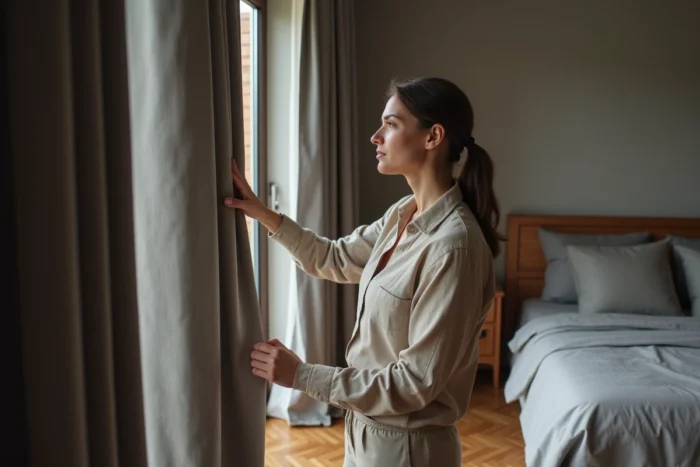
A blackout curtain is defined by its ability to block outside light thanks to a technical layer applied to the back of the fabric, most often a polymer coating. This layer makes all the difference between a simply thick curtain and a truly blackout curtain. Evaluating the effectiveness of a blackout curtain is not limited to reading a label: performance depends on the fabric, the construction, but also on how it is used daily.
The flashlight test to check the actual blackout of a curtain
Most guides focus on the initial choice (color, material, dimensions). Few explain how to check if a blackout curtain still fulfills its function after a few months of use. A simple method exists.
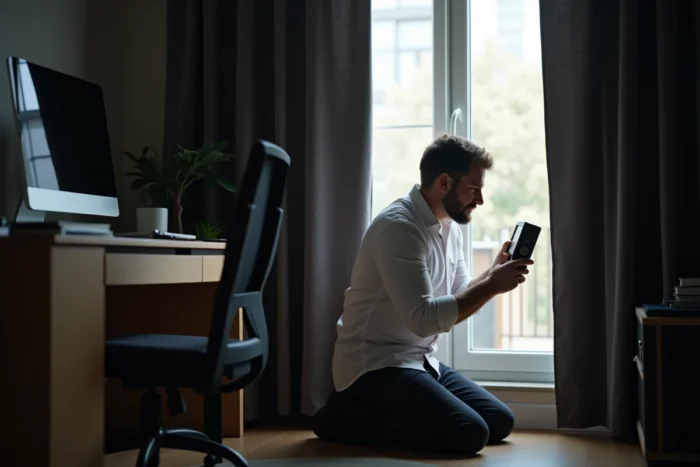
Place a flashlight behind the curtain in a dark room. If the beam of light clearly passes through the fabric, the blackout is no longer complete. The curtain then retains a decorative role, but it no longer effectively blocks light. This protocol, described by Vie Pratique (Ouest-France group), allows for the detection of degradation of the technical layer without specialized tools.
You will also find useful information on Direct Maison to delve deeper into the verification criteria for a blackout curtain over time.
This test is also worth doing at the time of purchase: in-store, bring the fabric close to a strong light source. A curtain that lets a diffuse halo through will never achieve total blackout, regardless of the displayed price.
Polymer coating and lining: what determines the fabric’s performance
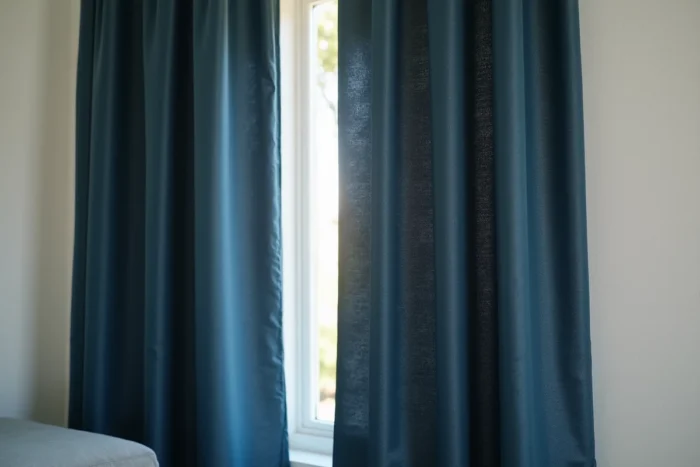
The effectiveness of a blackout curtain relies on its technical layer on the back of the fabric. This polymer coating acts as a shield against sunlight. Without it, even a very dense fabric allows light to filter through by transparency.
Two approaches coexist in the market. Some manufacturers integrate the coating directly into the weave. Others offer a separate lining, sewn or thermally bonded. The first option generally provides better durability over time, as the layer does not peel off.
Fabric weight and density
A fabric with a sufficiently dense weight contributes to thermal insulation in addition to light blocking. Lightweight curtains, even with a coating, lose performance against summer heat or winter cold.
The distinction between blackout curtains and thermal curtains deserves to be clearly stated. A blackout curtain blocks light. A thermal curtain reduces heat exchange between the window and the room. Some models combine both functions, but not all. Check the technical sheet: the mention “thermal” implies an air layer or a specific insulating lining, not just a thick fabric.
Washing and maintenance: the overlooked factor that destroys effectiveness
A new blackout curtain can lose its performance in a single poorly set washing cycle. Vie Pratique (Ouest-France group) notes that too high a temperature, strong spinning, or the dryer destroys the polymer coating that ensures light blocking.
The problem is rarely visible to the naked eye after washing. The fabric retains its appearance, color, and drape. Degradation can only be detected by redoing the flashlight test described above.
- Wash at low temperature, on a delicate cycle, without intensive spinning. Check the manufacturer’s label, as each coating has its own limits.
- Avoid the dryer. Prolonged heat weakens the polymer layer much faster than air drying.
- Never iron directly on the coated side. If ironing is necessary, turn the curtain inside out and use a low temperature.
A well-maintained blackout curtain retains its properties for several years. Poorly maintained, it can become a simple decorative curtain in a few months.
Blackout curtain and thermal insulation: real but limited effectiveness
Thermal curtains are sometimes presented as an alternative to window insulation. The reality is more nuanced. According to data from Vie Pratique, the thermal effectiveness of a curtain remains modest against heat, around a few tens of percent reduction in solar gain, while blocking all light.
In other words, a thermal blackout curtain reduces the feeling of heat in a room, but does not replace efficient glazing or external sun protection (shutters, awnings). It acts as a complement, particularly useful in homes where the installation of shutters is impossible.
Window coverage and air layer
The way the curtain covers the window radically changes its thermal effectiveness. A curtain that extends well beyond the window frame (at least several centimeters on each side) creates a layer of air between the glazing and the fabric. This air layer acts as a natural insulator, reducing temperature exchange.
A curtain that is too narrow, even of very good quality, allows heat or cold to bypass the fabric from the sides. Installation is as important as the product.
Concrete criteria for evaluating a blackout curtain before purchase
Rather than a list of marketing features, focus on the points that determine the actual performance of the curtain in your room.
- Check for the presence of a coating on the back of the fabric. A fabric that is simply thick or dark is not technically blackout.
- Measure your window and plan for a curtain that is wider and longer than the opening, to maximize coverage and the insulating air layer.
- Test the fabric in-store with a light source. If the light passes through, the curtain will not be blackout in your home either.
- Read the care instructions before purchase. If the manufacturer does not mention any washing precautions, the durability of the coating is uncertain.
Price alone guarantees nothing. A budget curtain with a proper coating and suitable maintenance will outperform an expensive model that is poorly maintained or poorly sized. Evaluating a blackout curtain hinges on three axes: the quality of the technical layer, the coverage of the window, and adherence to maintenance conditions over time.