
You wake up to find bites, small dark spots on the mattress, and the diagnosis is in: bedbugs. The reflex is to contact your home insurance. Disappointment comes quickly, as most multi-risk home insurance policies do not cover this type of infestation.
Why standard home insurance excludes bedbugs
A multi-risk home insurance (MRH) operates on a simple principle: it compensates for random and sudden disasters. Water damage, a fire, a storm. Bedbugs do not fall into this category.
Insurers consider a pest infestation as a lack of maintenance of the property, not as an unpredictable event. The logic is the same as for mold caused by insufficient ventilation: the standard contract does not provide for anything.
In practice, if you call your insurer after spotting bedbugs, they will refer you to the exclusion clauses of your contract. All major traditional insurers apply this principle. Without an explicit mention of pest coverage, you will not receive any compensation. To better understand bedbug home insurance coverage, it is necessary to distinguish the basic contract from the specific options that have emerged recently.
Pest coverage as an option: what neo-insurance covers
In recent years, neo-insurance and some startups have offered coverage dedicated to pests, including bedbugs. These options come in the form of additional modules, charged a few euros per month.

Wondering what these options actually cover? Here are the most common services:
- The intervention of a pest control professional, with one or two visits depending on the chosen plan.
- A temporary relocation if the property is uninhabitable during treatment, sometimes capped at a few nights.
- Additional support, such as psychological assistance, offered by certain contracts.
However, these guarantees have limits. Compensation caps remain low, often only a few hundred euros. Yet, professional treatment for bedbugs often costs much more, especially when multiple visits are needed in a large property.
Another point to check: the waiting period. Most of these contracts impose a waiting period after subscription, during which no infestation will be covered. Taking out pest coverage after spotting the first signs will therefore be of no use.
Compensation from the landlord: the legal route for tenants
When insurance does not cover treatment, tenants have another lever. The law requires landlords to provide decent housing, free from pests. This obligation is stated in the law of July 6, 1989, and was reinforced by the ELAN law of 2018.
If the infestation predates your arrival, the landlord must cover the treatment. The burden of proof can be complicated, but recent case law clearly favors tenants in this type of dispute.
A rarely addressed point by insurance comparators: the Court of Cassation has confirmed that a tenant can seek compensation for a period of three years preceding their request. This retroactive compensation can cover treatment costs, temporary relocation, and even loss of enjoyment if the property remained infested for months.
However, if the infestation appears during the lease and the tenant does not report the problem promptly, responsibility may shift. Reporting the infestation in writing at the first signs protects your rights.
Concrete steps in dealing with a landlord who refuses to act
The first step is to send a registered letter with acknowledgment of receipt, describing the infestation and requesting intervention. Keep photos, reports, and any written exchanges.
If the landlord does not respond, you can contact the departmental conciliation commission or the court. Recent decisions show that judges regularly award damages to tenants facing inaction from their landlord.
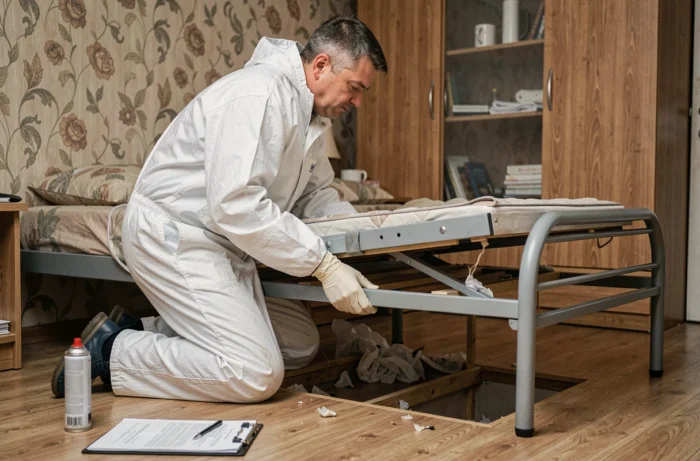
Home insurance contract and bedbugs: clauses to check before subscribing
Whether you are an owner-occupier or a tenant, reviewing your insurance contract with a specific angle changes the game. Not all contracts are equal, and the differences lie in the details.
- Check if a “pests” or “parasites” coverage is included in the special conditions, even if not activated.
- Look at the amount of the compensation cap: a cap that is too low will not cover a complete treatment for a multi-room apartment.
- Identify the waiting period: some offers impose several months before any coverage.
- Read the triggering conditions: some contracts require a diagnosis by an accredited professional before accepting the case.
A contract with pest coverage does not replace a quick response. The longer the infestation spreads, the more expensive the treatment becomes, and the more likely the reimbursement cap will be insufficient.
For an owner-occupier, the question is different. There is no legal obligation for a third party to finance the treatment. Pest coverage in home insurance then becomes the only safety net, provided it was subscribed in advance.
Bedbugs remain a blind spot in most home insurance contracts. Protection involves a combination of three elements: careful reading of your contract clauses, immediate reaction at the first signs of infestation, and knowledge of your rights against the landlord if you are a tenant. Waiting for the infestation to settle reduces all your options, whether they are insurance-related or legal.